AI Agent Marketplaces: How to List, Buy & Monetize Agents in 2026
April 20, 2026·17 min read
Every major cloud vendor shipped an agent marketplace in the last eighteen months. Salesforce, Google, Microsoft, and AWS are fighting over what is shaping up to be a multi-trillion-dollar digital labor market — and a long tail of developer-first marketplaces is forming underneath them. Here is how the category actually works in 2026: what to list where, how to monetize, how to buy without getting burned, and what marketplace-ready agent deployment looks like.
TL;DR
An ai agent marketplace is the App Store pattern applied to agentic software — but agents take actions on buyer data, so marketplaces add layers for permissions, audit, and runtime governance. The 2026 landscape splits into enterprise marketplaces (Salesforce AgentExchange, Google Agentspace/Gemini Enterprise, Microsoft Marketplace, AWS) and developer marketplaces (ClawHub, Claude Skills, GPT Store, MCP Hubs, Hugging Face Spaces, LangChain Hub, and others). Publishers monetize via subscription, usage, outcome, or private offers. Buyers need a structured evaluation framework — manifest, audit trail, supply chain, runtime isolation — because malicious marketplace agents are already in the wild.
Deploy marketplace agents safely in an isolated tenant:
Try Rapid Claw free — 5 msgs, then $29/mWhat Is an AI Agent Marketplace?
An ai agent marketplace is a distribution platform where publishers list pre-built autonomous agents — along with the tools, skills, and MCP servers they depend on — and buyers discover, evaluate, purchase, and deploy them into their own environment. On paper it looks like every other software marketplace. In practice, agent marketplaces are structurally different from app stores in three ways.
First, the unit of exchange is capability, not just code. An agent ships with a permission manifest (what it reads, what it writes, what endpoints it calls), a skill bundle, and often an MCP server or two. Second, the buyer is granting agency, not just running an executable. The agent will take actions on real data with real consequences — send the email, file the ticket, process the refund. Third, the governance surface extends past install. A traditional app runs; a marketplace agent acts, and the marketplace increasingly has to support audit logs, runtime policy, and revocation at the agent level, not just at the account level.
If you’re coming from the AI agent platform angle, the marketplace is the distribution layer sitting on top. The platform is where agents run; the marketplace is where they travel.
Why 2026 Is the Inflection Year
Agent marketplaces existed before 2026 — Hugging Face Spaces and the GPT Store both predate it. But the current wave is different for one reason: enterprise buyers showed up. Salesforce reports more than 200 launch partners on AgentExchange, including Google Cloud, Docusign, and Box. Microsoft Marketplace cleared 11,000 prepackaged models and 4,000+ AI apps and agents. Google folded the former Agentspace marketplace directly into Gemini Enterprise, positioning agent discovery as a native feature of its business platform rather than a side attraction.
The underlying shift is procurement. Enterprises already have purchase controls, SSO, BAAs, and audit mandates for software-as-a-service. They now expect the same for agentic-software-as-a-service — and they’ll only buy agents from places that can deliver those controls. That’s why the 2026 marketplace winners are the ones attached to existing enterprise procurement plumbing.
The market in one line
Every major cloud has a marketplace. Every major SaaS has a marketplace. Every major dev-tool vendor has a marketplace. Publishers don’t pick one — they pick the marketplaces where their ideal buyer already has a billing relationship, then invest in listing infrastructure that can fan out.
Major AI Agent Marketplaces in 2026
The landscape splits cleanly into two tiers. Enterprise marketplaces optimize for procurement, compliance, and line-of-business buyers. Developer marketplaces optimize for distribution velocity, discoverability, and end-user installs. Most mature publishers list in both tiers but tailor the package for each.
Enterprise marketplaces
Salesforce AgentExchange
Merges AppExchange, Slack Marketplace, and Agentforce into a single discovery surface. 10,000+ Salesforce apps, 2,600+ Slack apps and agents, 1,000+ Agentforce agents, sub-agents, tools, and MCP servers. Agentic search and intelligent app comparison are live now; streamlined Agentforce Builder install arrives fall 2026. Ideal if your buyer already lives in Salesforce.
Google Agentspace / Gemini Enterprise
The former AI Agentspace marketplace was folded into Gemini Enterprise, so agent creation, orchestration, and discovery are now part of Google’s business platform. Launch partners include Accenture, Deloitte, and Wipro. Strong for buyers already standardized on Workspace and Google Cloud.
Microsoft Marketplace
Microsoft combined Azure Marketplace and AppSource into one unified Microsoft Marketplace covering cloud solutions, AI apps, and agents. 11,000+ models and 4,000+ AI apps and agents. Flat 3% transaction fee, reduced renewal fees on eligible offers, and 100% of Marketplace purchases count toward a customer’s Azure commitment — a genuine procurement accelerator for enterprise buyers.
AWS Marketplace (AI & Agent category)
AWS promoted agentic AI to a first-class marketplace category, with Bedrock agents and third-party agent offerings bundled under unified billing and IAM. The strongest fit for buyers whose data gravity is already on AWS and who want private offers tied to EDP commits.
Developer marketplaces
ClawHub (OpenClaw skills)
The default skill registry for OpenClaw. High install velocity, but see the ClawHub custom skills walkthrough for how to build and publish safely — the supply-chain surface has been exploited more than once. Signed bundles and version pinning are table stakes.
Claude Skills
Currently free distribution. Heavy developer adoption and strong discovery within Claude products. Publishers use it for top-of-funnel reach and pair it with a paid surface elsewhere.
GPT Store
Revenue share on usage. Massive consumer reach, weaker on enterprise procurement. Best for broad-appeal agents that monetize on volume.
MCP Hubs
Distribution for MCP servers. If your agent’s value is a tool surface rather than a full workflow, this is where to list it. Composes naturally with agents hosted anywhere else.
Hugging Face Spaces, Replit Agent Market, LangChain Hub, Vercel Agent Gallery, Cloudflare AI Marketplace
A long tail of developer-first surfaces with distinct pricing mechanics — Replit runs direct-sale, Cloudflare bills on inference, LangChain leans into prompt and chain distribution. Pick the ones aligned with your runtime.
How to List and Monetize an Agent
Listing an agent isn’t zipping up a project. Every mature marketplace expects the same five artifacts — even if they call them different things. Get these right once and fan-out becomes mechanical.
1. Manifest
Declared permissions, tool surface, data scopes, and endpoint access. This is what the buyer reviews before installing and what the marketplace enforces at runtime.
2. Signed bundle
The agent code, skill files, and MCP server definitions, signed with a publisher key. Version-pinned. Reproducible.
3. Metering integration
Hooks into the marketplace billing surface so usage, tasks, or outcomes are metered and settled. This is where subscription vs. usage vs. outcome pricing is implemented.
4. Install flow
OAuth scopes, workspace provisioning, initial configuration, and any required MCP endpoints. The buyer's experience from click to first successful task.
5. Support & SLA page
Contact surface, incident runbook, CVE disclosure policy, support tier. Enterprise marketplaces gate on this; developer marketplaces reward publishers who ship it anyway.
Monetization models that actually work
The rev-share numbers worth remembering
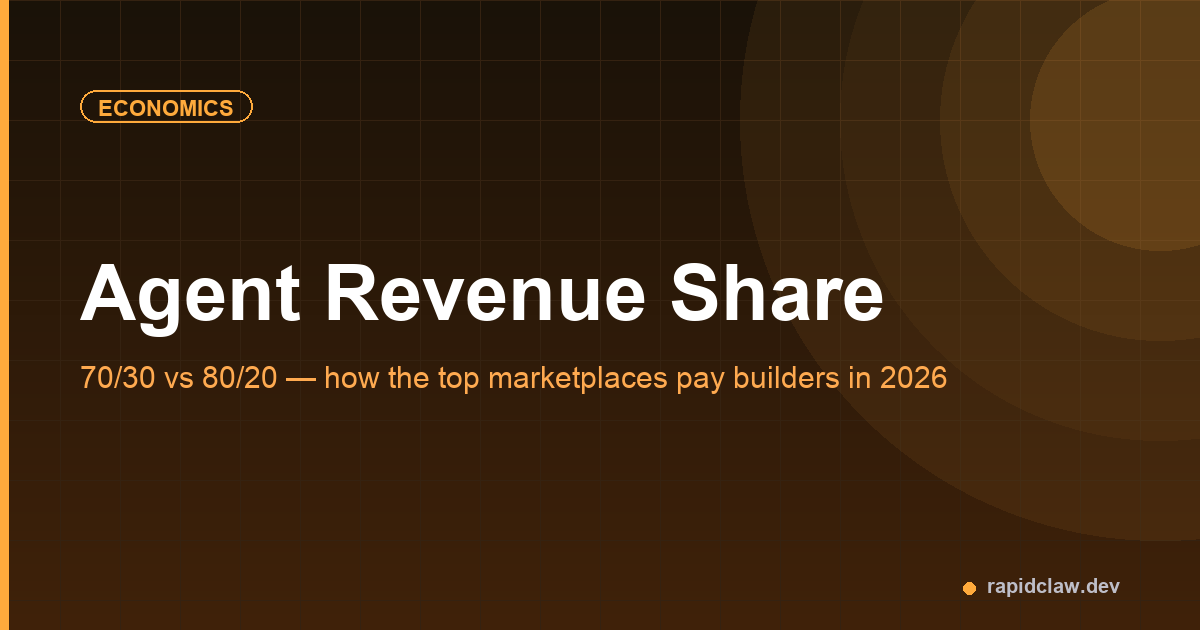
Enterprise marketplaces (Salesforce AgentExchange, AWS, Google Agentspace) typically pay publishers 70–80% of booked revenue. Developer marketplaces (GPT Store, Claude Skills) are still mostly free-tier with usage-based revenue share rolling out. Model your pricing against the primary surface — the others are upside.
Pricing choices have hardened into four patterns. Pick one as the primary — trying to run two at once confuses buyers and breaks forecast math.
Flat subscription
Per user, per workspace, or per deployment. Predictable for buyer, predictable for forecasting. Works best when the agent’s value is always-on (a virtual SDR, a support triage agent).
Usage-based
Per task, per document processed, per API call. Aligns cost with value when usage is spiky. Important to expose a cost cap or buyers will refuse to adopt.
Outcome-based
Per qualified lead, per closed ticket, per completed reconciliation. Highest trust signal but requires the marketplace to support outcome attestation — Google Cloud and AWS are ahead here.
Private offers
Custom pricing negotiated with enterprise buyers, transacted through the marketplace for procurement convenience. Microsoft and AWS handle these natively, including committed-spend offsets.
Fee structures matter more than they look. Microsoft Marketplace charges a flat 3% transaction fee, offers reduced renewal fees on eligible offers, and counts Marketplace purchases toward customer Azure commitments with no limit. Salesforce and Google use revenue share. Most developer marketplaces take a platform cut in the 15–30% range or run free distribution with optional paid promotion.
Discovery: getting your listing found
A marketplace listing isn’t a growth channel by default — it’s a storefront in a mall with ten thousand other stores. The publishers pulling real volume out of enterprise marketplaces in 2026 are treating listings like SEO targets, not like brochures. Three levers move the needle.
Problem-phrased titles. Agents buyers search for are phrased as jobs, not as tools. “Draft contract redlines for Salesforce quotes” beats “Legal agent v2.” AgentExchange’s agentic search and Microsoft Marketplace’s semantic ranking both reward descriptions that read like job postings. Write the title as a task the agent completes.
Proof surfaces. Enterprise buyers check three things before shortlisting: stated accuracy on a benchmark, named reference customers, and a published security posture. Listings that omit any of the three get filtered out in procurement. The irritating truth is that a mediocre agent with complete proof surfaces outsells a better agent without them.
Integration breadth. Cross-marketplace listings — the same agent on AgentExchange, Microsoft Marketplace, and ClawHub — compound. Most buyers evaluate agents in the marketplace of their dominant platform, but they prefer publishers who ship everywhere because it signals maturity. Fan out after your first marketplace is stable, not before.
Buyer’s Guide: Evaluating Marketplace Agents
The mistake buyers make is treating agent install like SaaS trial — click, grant scopes, see if it works. That’s fine for a read-only dashboard. It’s catastrophic for an agent that can execute actions across your systems. Run every candidate through the same five-question filter before it touches production data.
What’s in the permission manifest?
Read every declared scope. If the agent asks for write access to systems unrelated to its stated purpose, that's a deal-breaker. Demand least privilege.
Is the audit trail complete?
Can you see every tool call the agent made, with inputs, outputs, and timestamp? Without this you can't investigate incidents and you'll fail a SOC 2 audit.
What does the supply chain look like?
Signed bundle? Pinned version? Published CVE history? A publisher who can't answer these is asking you to trust anonymous code with production write access.
Can you isolate the runtime?
Run the agent in a dedicated tenant or VPC with default-deny egress and scoped keys. If the marketplace forces shared runtime, the blast radius of any compromise includes every customer on that runtime.
Is there a kill switch?
Can you revoke the agent's access in one click, independent of the publisher? Agent-level revocation at the marketplace layer is still uneven — verify before you install.
A practical shortlist process
Shortlist three candidates per use case. Run each in a staging tenant for two weeks with a capped budget, synthetic data, and full audit logging enabled. Compare task success rate, tool-call accuracy, and cost per completed task. Promote the winner into a limited production pilot behind a kill switch before any broad rollout.
Security: The Marketplace Threat Model
What happened in February 2026
Multiple marketplace-adjacent incidents landed in the same window: remote code execution in Claude Code, 1,184 malicious skills discovered in one OpenClaw skill registry, and 492 MCP servers exposed to the internet with zero authentication. Several of the malicious skills looked legitimate but secretly instructed AI coding assistants to install malware disguised as standard CLI tools. Marketplace review is not sufficient defense.
The marketplace threat model has three distinct surfaces, and they need separate mitigations:
Supply chain (publish side)
Compromised or tampered third-party agents, tools, plugins, registries, or update channels. Mitigations: signed bundles, version pinning, publisher attestation, automated scanning on every submission, CVE disclosure SLAs.
Runtime (install side)
Overbroad permissions, missing network isolation, shared runtime with other tenants. Mitigations: least-privilege manifests, default-deny egress, tenant-isolated VPCs, scoped API keys per tool. See the AI agent firewall setup guide for a concrete reference.
Decision trust (governance side)
Traditional third-party risk evaluates the counterparty organization. Agentic third-party risk has to evaluate the agent’s behavior — its permissions, its decision surface, and its telemetry. Expect OWASP Top 10 for Agentic Applications, agent-level audit requirements, and behavior-based risk scoring to become standard procurement questions in 2026.
None of this is theoretical. The EU AI Act compliance obligations and SOC 2 and HIPAA requirements for hosted agents both now call out marketplace-sourced agents as an elevated risk tier requiring additional controls. If you’re buying, your auditor will ask. If you’re selling, your buyers will ask on their behalf.
What the Next 12 Months Look Like
Four shifts are already visible in the 2026 marketplace landscape. None of them is controversial — the only question is how fast they arrive on any given platform.
Agent-to-agent procurement. Agents are already starting to make purchases on behalf of buyers. AgentExchange, Microsoft Marketplace, and Google all ship features aimed at agent-initiated transactions within approved budget envelopes. Security teams are rewriting third-party risk frameworks to account for this: entity trust is becoming decision trust, and buyers will demand per-transaction attestation, not per-vendor.
Runtime-attached listings. More marketplaces will ship with a bundled isolated runtime, so installing an agent provisions a sandboxed tenant automatically. AWS and Google are ahead; Salesforce is heading that direction. Publishers who haven’t designed for multi-tenant isolation will have a hard time keeping up.
Outcome attestation. Outcome-based pricing depends on a neutral party attesting that the outcome happened. Marketplaces are starting to ship this as a platform primitive — a signed receipt from the marketplace saying the lead was qualified, the ticket was resolved, the reconciliation was completed. Expect a standard to emerge here within 12 months.
Regulated-industry tiers. HIPAA, PCI, and FedRAMP-tier marketplace lanes are forming. Microsoft Marketplace already has separate compliance tracks; AWS is adding them. Publishers who invest in attestation early will dominate specific verticals long before general-purpose competitors catch up.
The meta-shift
All four trends point at the same thing: marketplaces are absorbing responsibilities that used to live in the buyer’s IT org. Identity, isolation, attestation, compliance. The marketplaces that win will be the ones that feel less like app stores and more like procurement operating systems — and the publishers that win will be the ones whose agents are built to run inside that system from day one.
Marketplace-Ready Deployment with Rapid Claw
Marketplaces solve discovery and procurement. They don’t solve runtime governance — that’s still the buyer’s problem. Rapid Claw is built for the install side of the marketplace equation: take any OpenClaw or Hermes Agent package from any marketplace and run it in a bounded environment where a misbehaving agent has a bounded blast radius.
Tenant-isolated VPC
Every deployment runs in its own network boundary. Default-deny egress. No shared runtime with other tenants. A marketplace agent that goes rogue can’t touch anything outside your tenant.
Scoped, auto-rotated keys
Each tool gets its own least-privilege key. Rotation runs automatically. A leak in one marketplace-sourced tool doesn’t compromise the others.
Permission manifests enforced
The manifest a marketplace agent declares is the manifest it gets. Attempts to exceed declared scope are blocked at the runtime layer and logged.
Full audit trail
Every tool call captured with inputs, outputs, and timestamps. Exportable for incident response and compliance. Agent-level revocation in one click.
The practical result: you can browse ClawHub, shortlist three agents for a use case, pilot them in isolation without touching production, and promote the winner — without building the firewall, rotation, and audit stack yourself. If you’re evaluating alternatives, the OpenClaw production deployment guide walks through what the DIY stack looks like.
Frequently Asked Questions
Pilot marketplace agents without the blast radius
Rapid Claw gives every marketplace-sourced agent an isolated tenant, scoped keys, enforced manifests, and a full audit trail. Deploy in under two minutes.
Deploy marketplace-readyRelated reading
Rate limiting, scoped keys, network isolation, and permission boundaries
SOC 2 & HIPAA for Hosted AgentsCompliance controls for marketplace-sourced agents
What Is an AI Agent Platform?The runtime layer beneath every marketplace
ClawHub Custom SkillsHow to publish skills to the OpenClaw skill registry
Agent Authentication & IdentityMarketplace agents need scoped identity, not borrowed user tokens