The $285B Wakeup Call: February 2026
It started with a Bain report. Then Deloitte published their own. Then Fortune ran the headline that sent shockwaves through every SaaS boardroom: “The era of one-tool-per-task is ending.”
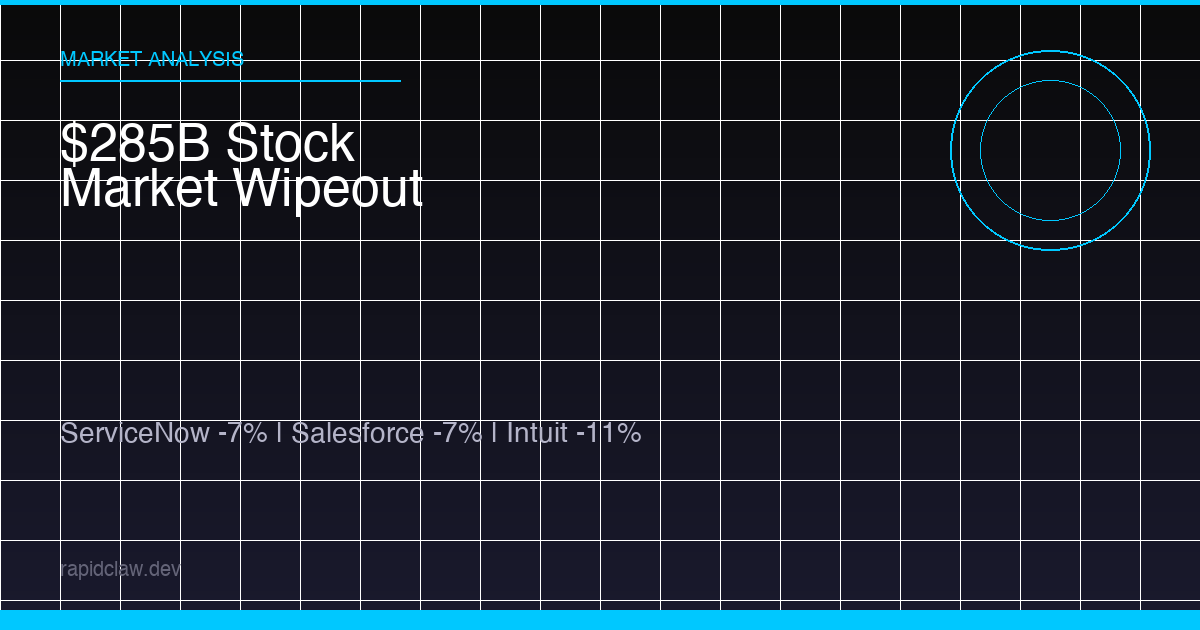
Within 72 hours, the market responded. ServiceNow lost 7% of its market cap. Salesforce shed another 7%. Intuit — the company behind QuickBooks, TurboTax, and Mailchimp — dropped 11%. Combined, over $285 billion in value vanished.
The thesis was simple: why pay for 15 separate SaaS subscriptions when a single AI agent can handle the workflow end-to-end?
This wasn’t speculation. Gartner had already published their projection: 35% of point-product SaaS will be replaced by AI agents by 2030. The market was just catching up to reality. Even Nvidia’s public agent strategy under Jensen Huang reads less like a hardware roadmap than a bet on this exact thesis.
From “One Tool Per Task” to “One Agent Per Outcome”
The SaaS model was built on a simple premise: every business function gets its own tool. CRM for sales. Zendesk for support. HubSpot for marketing. Gusto for payroll. QuickBooks for accounting. Slack for communication.
A typical SME runs 15–25 SaaS subscriptions. An enterprise runs 300+. Each with its own login, its own data silo, its own billing cycle, its own learning curve.
AI agents flip this model. Instead of buying a tool for each task, you deploy an agent for each outcome. The agent doesn’t care which tools it uses — it orchestrates whatever APIs, databases, and services it needs to get the job done.
Old model: “I need a CRM to track leads, an email tool to nurture them, a scheduling tool to book demos, and a proposal tool to close deals.”
New model: “I have a sales agent. It finds leads, qualifies them, sends personalized outreach, books meetings on my calendar, and drafts proposals. I just review and approve.” It is the same shift covered in how AI agents are replacing entire startup roles — only the unit of automation is a job description instead of a SaaS license.
9 Ways SMEs Are Already Replacing SaaS with AI Agents
This isn’t theoretical. Real businesses are already making the switch. Here are 9 SaaS categories where AI agents are taking over:
1. Customer Support → AI Support Agent
Replaces: Zendesk ($55/agent/mo), Intercom ($74/seat/mo), Freshdesk ($49/agent/mo)
An AI agent handles L1/L2 tickets, searches your knowledge base, drafts responses, and escalates only what needs a human. 80%+ of tickets resolved autonomously.
2. CRM → AI Sales Agent
Replaces: Salesforce ($25–300/user/mo), HubSpot ($45/seat/mo), Pipedrive ($14/seat/mo)
The agent tracks every interaction, scores leads automatically, sends follow-ups, and keeps your pipeline updated without anyone manually entering data.
3. Email Marketing → AI Outreach Agent
Replaces: Mailchimp ($20–350/mo), ConvertKit ($29/mo), ActiveCampaign ($29/mo)
Agent segments your audience, writes personalized emails, A/B tests subject lines, and optimizes send times — all without a marketing platform.
4. HR & Recruiting → AI People Agent
Replaces: BambooHR ($8/employee/mo), Greenhouse ($6,000+/yr), Lever
Screens resumes, schedules interviews, sends rejection/acceptance emails, onboards new hires with custom checklists. The repetitive 80% of HR, automated.
5. Project Management → AI Ops Agent
Replaces: Asana ($10.99/user/mo), Monday.com ($9/seat/mo), ClickUp ($7/member/mo)
Breaks down projects into tasks, assigns based on team capacity, sends status updates, flags blockers, and generates weekly reports. No dashboard babysitting.
6. Accounting & Bookkeeping → AI Finance Agent
Replaces: QuickBooks ($30–200/mo), Xero ($15–78/mo), FreshBooks ($19/mo)
Categorizes transactions, reconciles accounts, generates P&L statements, flags anomalies, and prepares tax documents. Your bookkeeper that never sleeps.
7. Social Media Management → AI Content Agent
Replaces: Hootsuite ($99/mo), Buffer ($6/channel/mo), Sprout Social ($249/seat/mo)
Monitors trends, drafts posts, generates images, schedules across platforms, and responds to comments. Multi-channel presence without the tool sprawl.
8. Data Analytics → AI Insights Agent
Replaces: Mixpanel ($25/mo+), Amplitude ($49/mo+), Tableau ($75/user/mo)
Queries your database directly, builds dashboards on demand, spots trends, and sends proactive alerts when metrics move. Ask questions in plain English, get answers.
9. Scheduling & Calendar → AI Coordination Agent
Replaces: Calendly ($10/seat/mo), SavvyCal ($12/user/mo), Cal.com
Handles meeting requests via email, finds optimal times across time zones, sends confirmations, reschedules automatically, and preps you with context before each meeting.
Which SaaS Categories Are Most Vulnerable?
Not all SaaS is equally exposed. The categories most at risk share three traits: high per-seat costs, repetitive workflows, and data that agents can access via APIs.
| Category | Risk Level | Why |
|---|---|---|
| Customer Service | Critical | 80%+ of tickets are repetitive L1/L2 |
| CRM | Critical | Most CRM work is data entry agents do better |
| HR & Recruiting | High | Screening, scheduling, onboarding are pure process |
| Email Marketing | High | Personalization at scale is an agent superpower |
| Bookkeeping | High | Transaction categorization is pattern matching |
| Project Management | Medium | Humans still want visual boards, but reporting is automatable |
| Dev Tools / CI-CD | Low | Deep integrations and compliance requirements create moats |
Why Enterprise Software Replacement Is Harder Than It Seems
Before you start celebrating the death of Salesforce, pump the brakes. Enterprise SaaS replacement is a different beast. Here’s why:
- Compliance moats: SOC 2, HIPAA, GDPR, FedRAMP certifications took years to build. Agents need to match these, not just functionally replicate.
- Data gravity: 10 years of CRM data in Salesforce creates switching costs that go beyond software. Migration is a multi-quarter project.
- Procurement inertia: Enterprise contracts are 3–5 years. Even if agents are better today, the contract runs through 2029.
- Integration depth: 300+ app ecosystems with custom integrations. An agent replacing Salesforce also needs to replace the 47 tools plugged into it.
- Audit trails: Regulated industries need deterministic outputs. Agent probabilistic reasoning needs guardrails before it can replace compliant SaaS.
The bottom line: SMEs and startups will replace SaaS with agents first. Enterprise will follow, but on a 3–5 year lag. The Gartner 35% figure is mostly SME-driven. The teams that succeed in the enterprise wave are the ones already investing in enterprise-grade agent deployment patterns — SSO, audit, region-pinning — so procurement says yes the day the contract clock runs out.
The earliest practical wins show up in regulated SMB verticals where the SaaS tax is steep but the per-seat math no longer pencils out: small healthcare practices replacing patient-flow SaaS with HIPAA-conscious agents, independent bookkeeping and accounting firms automating month-end, and insurance brokerages running their own quote-pipeline agents. None of those replace their full stack on day one — they peel off one workflow at a time.
How Self-Hosted Agents on Dedicated VPS Enable the Transition
The SaaS-to-agent transition has a dirty secret: most “AI agent” platforms are just... more SaaS. They charge per seat, lock your data in their cloud, and add another subscription to the pile.
Self-hosted agents on dedicated VPS infrastructure solve this. You own the compute. You own the data. You control the costs. No per-seat pricing. No vendor lock-in. The DIY-VPS-versus-managed trade-off is laid out in detail in the self-host vs managed OpenClaw cost breakdown — including the failure mode where a $24 droplet looks cheaper until it OOMs at 1.4 GB.
This is exactly what RapidClaw was built for — managed agent hosting on dedicated VPS instances. (For the broader landscape, see our AI agent hosting guide and our breakdown of why per-seat pricing fails for agents.) You get the control of self-hosting without the DevOps overhead:
- Dedicated VPS per agent — no noisy neighbors, predictable performance
- One-click deployment — go from framework to production in 60 seconds
- Your data stays on your infra — full data sovereignty, no third-party cloud storage
- Flat pricing per agent — not per seat, not per query, not per token
The Real Cost Comparison: $500/mo SaaS Stack vs $200/mo AI Agent
Let’s do the math for a typical 5-person startup running the standard SaaS stack:
Traditional SaaS Stack
- Salesforce CRM — $125/mo (5 seats)
- Zendesk — $55/mo (1 agent)
- Mailchimp — $45/mo
- QuickBooks — $60/mo
- Asana — $55/mo (5 seats)
- Calendly — $40/mo (4 seats)
- Hootsuite — $99/mo
- Slack Pro — $36/mo (5 seats)
$515/mo
+ onboarding, training, context-switching
RapidClaw AI Agents
- Sales Agent (CRM + outreach) — $29/mo
- Support Agent (tickets + KB) — $29/mo
- Ops Agent (PM + scheduling + comms) — $29/mo
- Finance Agent (bookkeeping) — $29/mo
- Token costs (est.) — $80/mo
$196/mo
Flat pricing. No per-seat. Full data ownership.
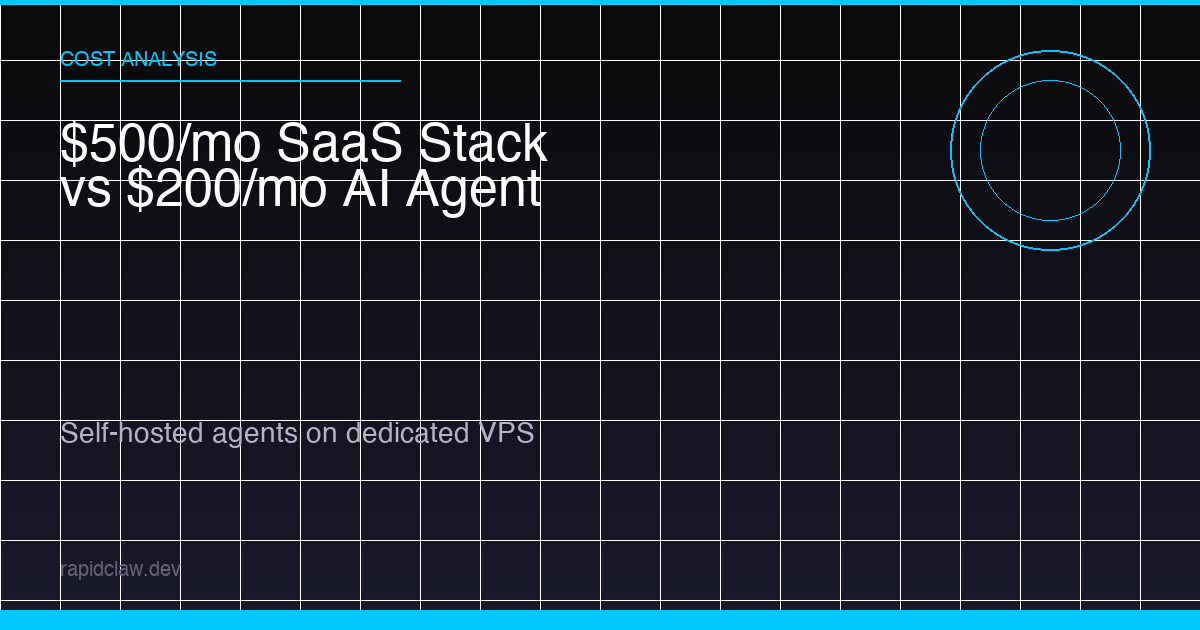
That’s a 62% cost reduction — and the savings compound as you grow. SaaS scales linearly with headcount (more seats = more cost). Agents scale with compute, which gets cheaper every year.
At 20 people, the SaaS stack balloons to $2,000+/mo. The agent stack? Still under $300.
What Happens Next: The 2026–2030 Timeline
Based on current trajectories from Gartner, Bain, and Deloitte, here’s how the SaaSpocalypse unfolds:
- 2026: Early adopters (startups, solopreneurs, agencies) replace 3–5 SaaS tools with agents. SaaS stocks continue correcting.
- 2027: Mid-market SMEs follow. Agent frameworks mature. MCP and A2A protocols become standard. Interoperability solved.
- 2028: Enterprise pilots at scale. Compliance-certified agent platforms emerge. SaaS vendors pivot to “agent-native” branding.
- 2029–2030: Gartner’s 35% replacement target hit. Point-product SaaS either evolves into agent infrastructure or consolidates/dies.
The SaaS companies that survive will be the ones that become agent infrastructure — the platforms agents run on, not the tools agents replace. The same logic explains why the “MCP servers are dead” shake-up matters: the connective tissue between agents and tools is becoming the actual moat.
Ready to Replace Your SaaS Stack?
Deploy AI agents on dedicated VPS infrastructure in 60 seconds. No per-seat pricing. Full data ownership. Start replacing SaaS today.
Deploy in 5 Min — 5 msgs free, then $29/mStarting at $29/agent/mo — cancel anytime