AI Agent Pricing Models Compared [2026 Guide]
Per-seat, per-resolution, per-task, hybrid — which pricing model actually makes sense for AI agents? We break down every model with real examples, cost math, and recommendations for every business size.
April 22, 2026·18 min read
4
Pricing models
$29
Lowest/agent/mo
73%
Savings vs per-seat
What's in this guide
- 01Why AI Agent Pricing Is Broken
- 02The 4 Pricing Models Explained
- 03Why Per-Seat Fails for AI Agents
- 04Outcome-Based Pricing: The Future
- 05Real-World Examples: Bland, Parloa, HappyRobot
- 06RapidClaw Pricing: $29/$200 per Agent + $100/Additional
- 07Cost Comparison Table
- 08Which Model Fits Your Business
- 09FAQ
1. Why AI Agent Pricing Is Broken
Most AI agent platforms borrowed their pricing from SaaS — per-seat, per-month, maybe a usage tier thrown in. The problem is that AI agents aren't SaaS users. They don't log in. They don't have lunch breaks. One agent can do the work of five humans or sit idle for a week depending on the workload.
When you force SaaS pricing onto AI agents, you get a mismatch: companies pay for seats that aren't “occupied” in any meaningful way, costs don't scale with value delivered, and there's no incentive for the vendor to make agents more efficient. The result? Bloated bills, underutilized agents, and buyer's remorse.
The industry is shifting. In 2026, we're seeing a clear move toward outcome-based and hybrid models that tie cost to actual results. Let's break down every pricing model, show you where each one works (and fails), and help you pick the right one.
2. The 4 Pricing Models Explained
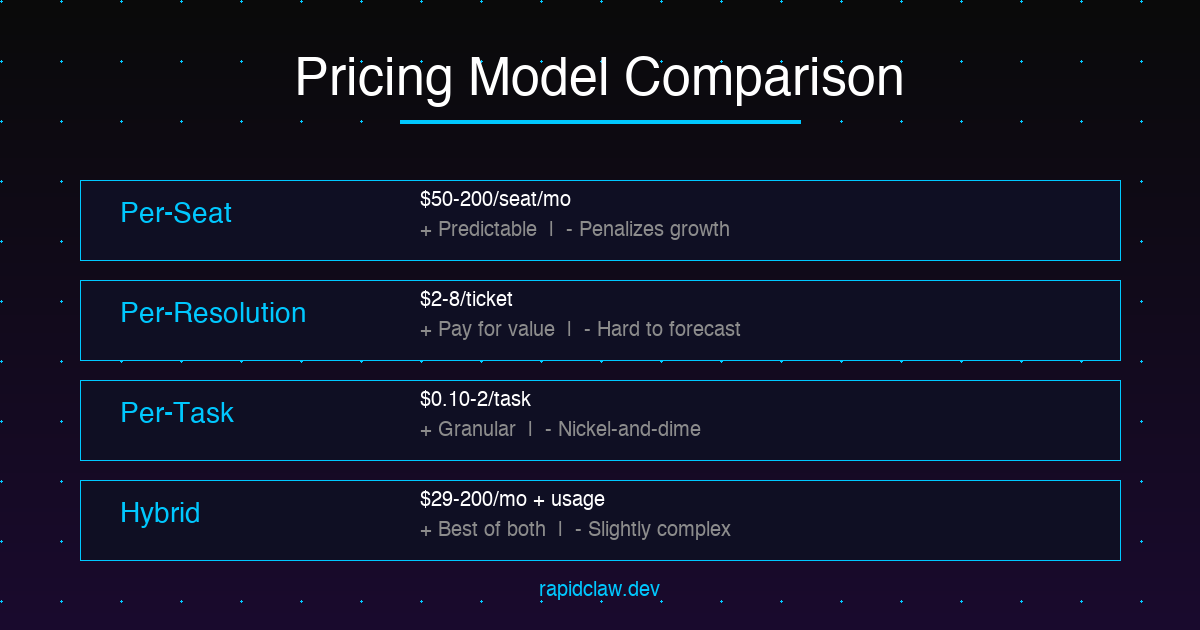
Per-Seat Pricing
The most familiar model. You pay a flat monthly fee per “seat” or per agent instance. Pricing typically ranges from $50–$200 per seat per month.
Example: A customer service team deploys 5 AI agents at $100/seat. Monthly cost: $500 fixed, regardless of whether those agents handle 50 tickets or 5,000.
Best for: Enterprises that want predictable budgets and have consistent, high-volume workloads. Worst for: Startups and growing teams where agent usage fluctuates wildly.
Per-Resolution Pricing
You only pay when the agent actually resolves something — a support ticket, a lead qualification, a data extraction. Rates range from $2–$8 per resolved ticket for support agents, $5–$25 per qualified lead for sales agents.
Example: Your agent resolves 200 support tickets at $4/resolution. Monthly cost: $800. If volume drops to 50 tickets, cost drops to $200. Perfect alignment.
Best for: Support and sales teams with variable volumes. Worst for: Teams that need cost predictability for budgeting.
Per-Task Pricing
Granular pricing where every action the agent takes has a cost. Send an email: $0.10. Run a database query: $0.25. Generate a report: $2.00. This is common in automation-heavy workflows.
Example: An agent processes 1,000 tasks per month at an average of $0.50/task. Monthly cost: $500. Very transparent, but the per-task charges add up fast.
Best for: High-volume, low-complexity workflows. Worst for: Complex multi-step agents where a single “resolution” requires 20+ tasks.
Hybrid Pricing
A flat base fee for infrastructure plus variable costs for actual usage. This is where the market is heading. You get budget predictability from the base fee and fair scaling from the usage component.
Example: $29/month base for one agent on a dedicated VPS + your own API key costs. No per-token markup, no surprise bills. Infrastructure cost is fixed, token costs scale with actual use.
Best for: Most businesses. You get cost control without paying for idle capacity. Worst for: Teams that want zero variable costs (rare in the AI agent world).
3. Why Per-Seat Fails for AI Agents
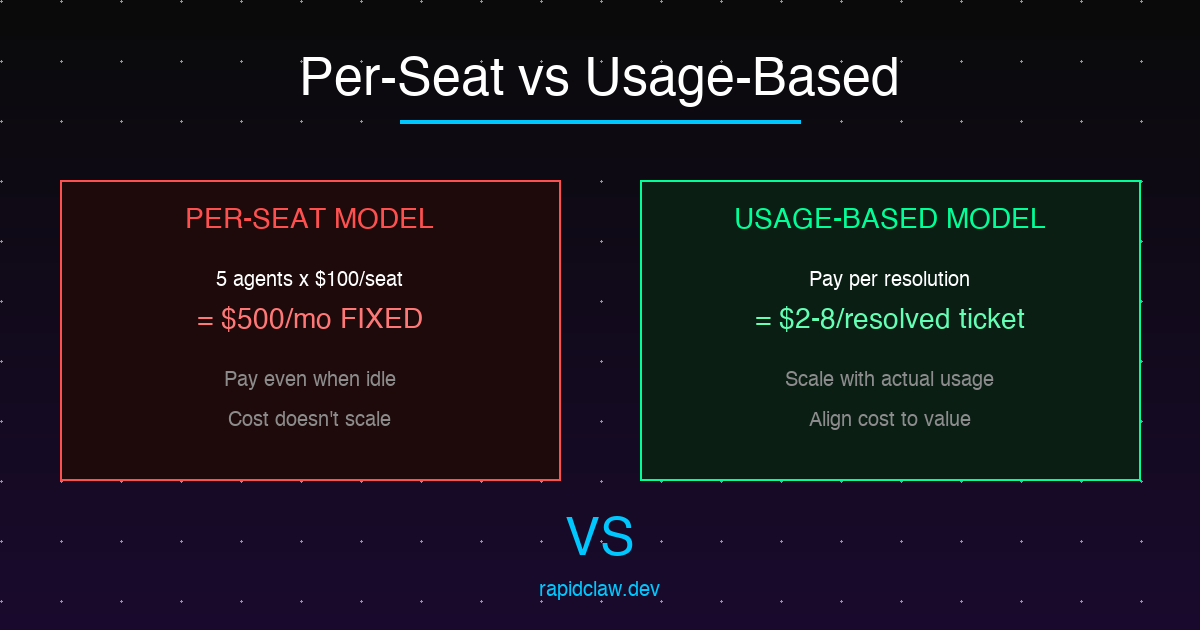
Per-seat pricing made sense when every “user” was a human who consumed roughly the same amount of resources. AI agents shatter that assumption in three ways:
1. Agents aren't equal
One agent might handle 50 tickets/day. Another handles 5. With per-seat pricing, they cost the same. That's not fair to you or to the vendor.
2. It penalizes adoption
Want to deploy a lightweight monitoring agent alongside your main support agent? That's another seat. Per-seat pricing creates friction against deploying more agents, even when it's the right architectural decision.
3. No incentive alignment
The vendor makes the same money whether your agent resolves 100 tickets or crashes every hour. Per-seat pricing decouples cost from value, which is the opposite of what you want.
The math is stark: a team paying $150/seat for 10 AI agents spends $1,500/month regardless of output. Switch to per-resolution at $4/ticket, and 300 monthly resolutions costs $1,200 — with cost directly tied to results. If volume drops, so does the bill.
4. Outcome-Based Pricing: The Future
Outcome-based pricing is the logical evolution. Instead of charging for inputs (seats, tasks, API calls), you charge for outputs (resolved tickets, qualified leads, completed workflows). This is where the smartest AI agent vendors are moving.
Here's how outcome-based pricing breaks down by use case:
| Use Case | Outcome Metric | Typical Price | Tier |
|---|---|---|---|
| Customer Support | Resolved ticket | $2–$8 | Tier 1 |
| Sales Qualification | Qualified lead | $5–$25 | Tier 2 |
| Data Extraction | Successful extraction | $0.50–$3 | Tier 1 |
| Code Review | Reviewed PR | $1–$5 | Tier 2 |
| Complex Workflow | Completed workflow | $25–$80 | Tier 3 |
The tiered approach works well: Tier 1 ($2–$8) for simple, high-volume tasks. Tier 2 ($8–$25) for medium-complexity outcomes. Tier 3 ($25–$80) for complex, multi-step workflows that replace hours of human work.
How Rapid Claw prices it
Flat infrastructure fee, no per-token markup. $29/mo for one agent, $200/mo for five, plus your own model API key billed at provider rates. Predictable. No surprise bills.
5. Real-World Examples: Bland, Parloa, HappyRobot
Let's look at how three real AI agent companies price their products and what you can learn from each approach.
Bland AI — Per-Minute Voice Agents
Bland charges $0.09/minute for AI phone agents. This is essentially per-task pricing applied to voice conversations. A 5-minute support call costs $0.45. At 1,000 calls/month averaging 4 minutes, you're looking at roughly $360/month.
Why it works: Voice calls have a natural time boundary. Per-minute pricing is intuitive for buyers who already think in call-center terms. The catch: Complex calls that require multiple transfers or escalations can balloon costs unpredictably.
Parloa — Enterprise Per-Resolution
Parloa targets enterprise contact centers with outcome-based pricing. They charge per successfully resolved conversation, not per message or per minute. If the agent can't resolve the issue and escalates to a human, you don't pay the full rate.
Why it works: Enterprise buyers love this because it directly ties cost to value. If the agent isn't performing, the vendor eats the cost. The catch: Minimum commitments and custom pricing mean you need serious volume (typically 10,000+ conversations/month) to get started.
HappyRobot — Per-Action Logistics Agents
HappyRobot builds AI agents for freight and logistics. They charge per action: scheduling a load, updating a status, processing a rate confirmation. Each action has a fixed price, and you only pay for what the agent actually does.
Why it works: Logistics operations have well-defined, repeatable tasks. Per-action pricing maps perfectly to existing operational workflows. The catch: Agents that perform many small actions per workflow can accumulate costs quickly without obvious visibility.
6. RapidClaw Pricing: $29/$200 per Agent + $100/Additional
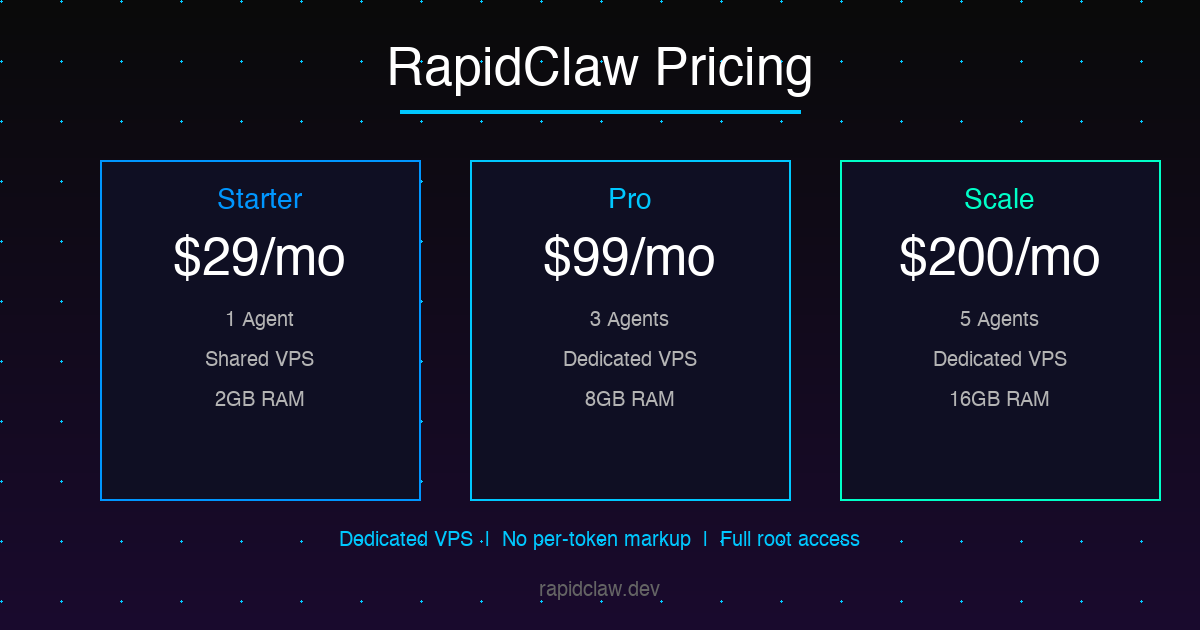
RapidClaw uses a hybrid model: flat infrastructure pricing per agent, with no per-token markup. You bring your own API keys and pay the model providers directly at their standard rates. The RapidClaw fee covers the dedicated VPS, security hardening, monitoring, and deployment infrastructure.
Chat & Automate
$29/mo
- 1 agent
- Includes $20 API credits
- Chat & automation tools
- Community support
Builder Sandbox
$200/mo
- 1st agent included
- Includes $100 API credits
- Dedicated VPS
- Priority support
Additional Agents
$100/each/mo
- 3rd, 4th, 5th agents
- Scale your fleet
- Same dedicated infra
- Up to 5 agents total
The key difference from competitors: no per-token markup. Most managed platforms add a 20–40% surcharge on top of model provider rates. With RapidClaw, you use your own API keys and pay OpenAI, Anthropic, or Google directly. For a team spending $200/month on tokens, that's $40–$80/month in savings right there — and it compounds fast if your token costs push into six figures a year.
Every agent runs on its own dedicated VPS (Builder Sandbox tier) with full root access. You're not sharing compute with other customers. If you need to SSH in, install custom dependencies, or run a sidecar process — go for it. It's your server.
7. Cost Comparison Table
Here's a head-to-head comparison for a team running 3 AI agents handling 500 tasks/month:
| Model | Monthly Cost | Cost/Task | Scales With |
|---|---|---|---|
| Per-Seat ($100/seat) | $300 | $0.60 | Headcount |
| Per-Seat ($150/seat) | $450 | $0.90 | Headcount |
| Per-Resolution ($4/res) | $2,000 | $4.00 | Output volume |
| Per-Task ($0.50/task) | $250 | $0.50 | Task volume |
| RapidClaw Builder Sandbox ($200/mo) | $200 + tokens | $0.40* | Token usage |
*RapidClaw cost/task assumes average token cost of ~$0.01/task at provider rates. Infrastructure cost ($200) divided across 500 tasks = $0.40. Total effective cost/task: ~$0.41. Includes $100 in API credits.
8. Which Model Fits Your Business
There's no universal best pricing model. The right choice depends on your stage, volume, and how predictable your agent usage is.
Solo founders & small teams (1–3 agents)
Best model: Hybrid (flat base + BYOK tokens). You want predictable infrastructure costs without per-token markups. RapidClaw Starter at $29/mo is built for this.
Growing startups (3–10 agents)
Best model: Hybrid or per-resolution. If your agents handle support tickets, per-resolution aligns cost to value. For general-purpose agents, hybrid pricing at the Pro/Scale tier keeps costs manageable.
Mid-market (10–50 agents)
Best model: Per-resolution or negotiated hybrid. At this scale, per-resolution pricing often wins because the volume discounts kick in and your agents are handling enough tickets to make outcome-based pricing very competitive.
Enterprise (50+ agents)
Best model: Custom enterprise agreements with committed volume discounts, SLAs, and dedicated support. Most vendors at this scale offer custom pricing that blends per-resolution and flat fees.
9. FAQ
What is the best pricing model for AI agents?
Hybrid pricing (flat infrastructure fee + usage-based tokens) works best for most businesses. It gives you cost predictability while scaling fairly with actual usage. Per-resolution works well specifically for support and sales agents.
How much do AI agents cost per month?
Managed hosting starts at $29/month (RapidClaw Starter). Mid-tier plans run $200/month. Enterprise deployments with dedicated infrastructure can cost $500–$5,000+/month. Add LLM token costs of $50–$500/month depending on volume — see our self-host vs managed breakdown for the full math.
Why is per-seat pricing bad for AI agents?
Per-seat pricing was designed for human users. AI agents have wildly different resource consumption patterns. One agent might handle 10x the workload of another. Per-seat pricing penalizes broad deployment and doesn't align cost with value.
What is outcome-based pricing for AI agents?
Outcome-based pricing charges per result: $2–$8 per resolved ticket, $5–$25 per qualified lead, $25–$80 per completed complex workflow. It aligns vendor incentives with customer success and is the direction the industry is moving.
Does RapidClaw charge per token?
No. RapidClaw uses a flat infrastructure fee ($29/$200 per month, plus $100/additional agent) with no per-token markup. You bring your own API keys and pay model providers directly at their standard rates. This can save 20–40% compared to platforms that mark up token costs.
Stop Overpaying for AI Agent Infrastructure
RapidClaw gives you dedicated VPS hosting at $29/mo with no per-token markup. Deploy your first agent in under 5 minutes.
Deploy in 5 Min free — 5 msgs, then $29/mRelated reading
- AI Agent Hosting: The Complete Guide — infrastructure options compared
- Why AI Agent Token Costs Hit $100K/Year — the hidden cost driver
- AI Agent ROI Calculator — run the numbers on your use case
- Deploy OpenClaw to Production — step-by-step deployment guide
- AI Agent for IT Ticketing — Pricing Tiers + Setup Guide — how the three-tier model plays out for a single use case
- Agentic Commerce: Shopping Agents 2026 — how pricing shifts when agents become the buyer