5 CrewAI Alternatives That Actually Handle Deployment
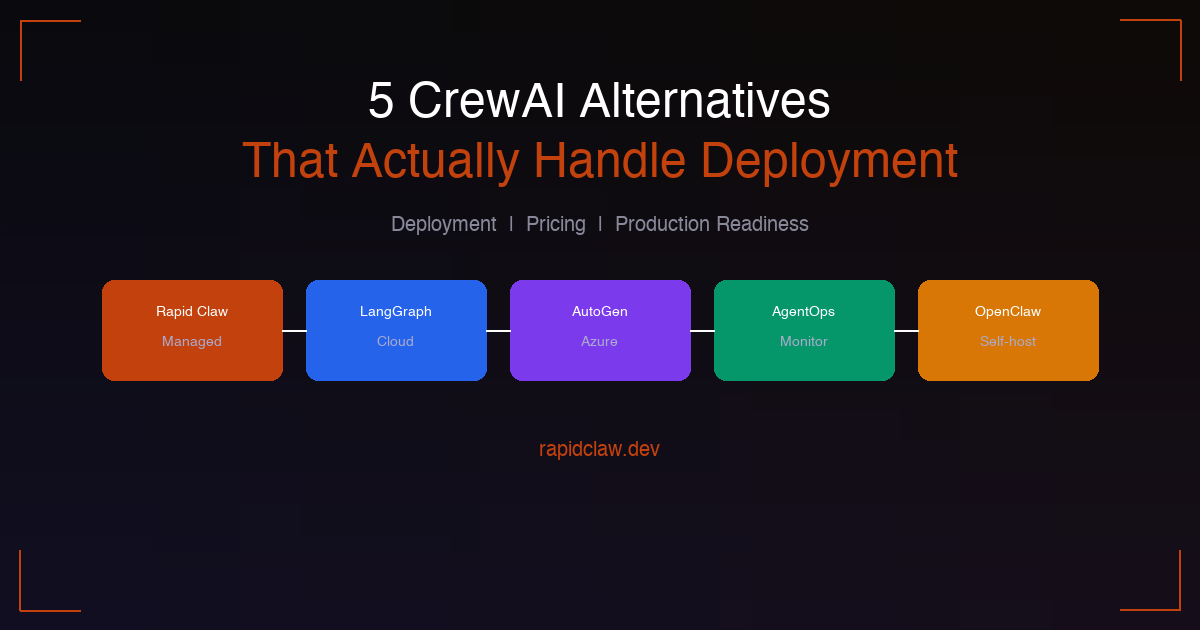
CrewAI nails multi-agent orchestration. Getting it into production? That's a different story. Here are five platforms that solve the deployment problem CrewAI leaves on your desk.
April 16, 2026·12 min read
5
Alternatives compared
1
Fully managed option
2026
Updated for
The CrewAI Deployment Problem
CrewAI is one of the most popular multi-agent frameworks out there, and for good reason. The role-based agent model — where you assign a Researcher, Writer, and Editor to a crew — maps cleanly to how real teams work. The Python API is approachable. The documentation is solid.
But there's a gap between “my crew runs locally” and “my crew runs in production.” CrewAI doesn't offer managed hosting. There's no crewai deploy command that provisions infrastructure, handles SSL, or restarts crashed agents. When you're ready to go live, you're on your own with Docker, a VPS, monitoring, secrets management, and the inevitable 3 AM debugging session.
For teams that have dedicated DevOps, this is manageable. For solo founders, small teams, and anyone who would rather ship product than fight YAML configs, it's a real blocker. That's why people start searching for CrewAI alternatives that have a deployment story baked in.
This guide covers five platforms that solve deployment differently. One is fully managed. Others give you deployment tooling, cloud infrastructure, or a simpler architecture. We'll compare what each one does, how deployment works, who it's best for, and what it costs. If you want the broader picture of what an agent platform actually does before drilling into the alternatives, that primer covers orchestration, deployment, monitoring, and security as a single category.
For context on how all the major frameworks stack up across other dimensions, see our AI Agent Framework Comparison 2026.
Quick Comparison
| Platform | Deployment | Multi-Agent | Best For | Pricing |
|---|---|---|---|---|
| Rapid Claw | Fully managed | Via OpenClaw / Hermes | Solo founders, fast deploy | $29–200/mo |
| LangGraph Cloud | Managed (LangSmith) | Graph nodes | Complex workflows | Free tier + usage |
| AutoGen (Microsoft) | Azure integration | Conversations | Research, code gen | Open source + Azure |
| AgentOps | Observability layer | Framework-agnostic | Monitoring, debugging | Free tier + paid |
| OpenClaw (self-hosted) | Single-process | Single agent | Simple agents, low ops | Free (OSS) + VPS |
The 5 Alternatives, In Detail
1. Rapid Claw — Fully Managed Agent Hosting
Rapid Claw isn't an agent framework — it's the deployment platform that frameworks like CrewAI are missing. It provides one-click managed hosting for OpenClaw and Hermes Agent, the two open-source agent frameworks where managed deployment eliminates the most pain.
The deployment story is the entire point. You pick a framework, connect your API keys, and your agent is running in production in under 60 seconds. Rapid Claw handles the infrastructure you'd otherwise spend days setting up: isolated Docker containers, AES-256 encryption at rest, automatic SSL, CVE auto-patching, health monitoring with automatic restarts, and custom domain support.
For teams migrating off CrewAI, the path typically goes: rewrite your agent logic to use OpenClaw or Hermes (which is simpler than it sounds since most CrewAI crews are thin wrappers around prompt chains), deploy on Rapid Claw, and delete your Docker Compose files. If you're coming from a multi-agent CrewAI setup, Hermes Agent's sub-agent architecture handles most of the same patterns with less token overhead. See our migration guide for the step-by-step.
Not ready to migrate? If the specific thing you want from Rapid Claw is the cost-saving model routing, we've extracted that as a standalone open-source library — agent-router. You can drop it into an existing CrewAI crew to route lightweight sub-tasks (classification, extraction, formatting) to Haiku-tier models while keeping the heavy reasoning on Sonnet. Keeps your CrewAI architecture, cuts the token bill.
Rapid Claw at a glance
- •Deployment: Fully managed. One-click deploy, 60 seconds to production.
- •Frameworks: OpenClaw, Hermes Agent
- •Best for: Solo founders, small teams, anyone who doesn't want to manage infra
- •Pricing: Chat & Automate at $29/mo ($20 API credits), Builder Sandbox at $200/mo ($100 API credits, $100/mo per additional agent), Enterprise from $3K+ setup. See pricing.
- •Trade-off: Limited to OpenClaw and Hermes — no CrewAI or LangGraph hosting (yet)
2. LangGraph Cloud — Graph-Based Orchestration with Managed Deployment
LangGraph models agent workflows as directed graphs: nodes are processing steps, edges define the flow. It's the power tool of the multi-agent space. Where CrewAI gives you role-based teams, LangGraph gives you fine-grained control over branching logic, parallel execution, human-in-the-loop checkpoints, and conditional routing.
The deployment story has improved significantly. LangGraph Cloud (part of LangSmith) lets you deploy graphs as hosted APIs with built-in state persistence, streaming, and cron-based scheduling. You push your graph definition, and LangSmith handles serving it. It's not as turnkey as Rapid Claw — you still need to define your graph, manage API keys, and handle the LangSmith dashboard — but it's miles ahead of self-hosting a LangGraph app on raw infrastructure.
The trade-off is complexity. LangGraph's graph abstraction has a real learning curve. If your use case is “I need an agent that answers customer questions,” LangGraph is overkill. If your use case is “I need agents that follow a 12-step approval workflow with conditional branches and parallel execution,” nothing else comes close.
LangGraph Cloud at a glance
- •Deployment: LangSmith-hosted APIs, or self-hosted containers
- •Multi-agent: Graph nodes with parallel and conditional execution
- •Best for: Complex branching workflows, human-in-the-loop, advanced orchestration
- •Pricing: Free tier for development, usage-based pricing for production (LangSmith Plus from $39/seat/mo)
- •Trade-off: Steep learning curve, heavier engineering investment upfront
3. AutoGen (Microsoft) — Conversational Multi-Agent with Azure Integration
AutoGen takes a different approach to multi-agent systems: agents communicate by passing messages to each other in conversation-like patterns. The framework excels at code generation with execution verification, multi-agent debate, and iterative refinement workflows where agents need to go back and forth.
Deployment-wise, AutoGen's biggest advantage is the Microsoft ecosystem. If you're already on Azure, deploying AutoGen agents through Azure Container Apps or Azure Functions is the path of least resistance. AutoGen Studio provides a visual interface for designing and testing agent teams, and the Azure integration handles scaling, monitoring, and secrets management.
The gap: AutoGen is still more of a research framework than a production platform. Documentation for production deployment is thinner than LangGraph's or Rapid Claw's. The conversational architecture can lead to unpredictable token consumption when agents enter long exchanges. And if you're not on Azure, deployment requires significantly more DIY infrastructure work.
AutoGen at a glance
- •Deployment: Azure Container Apps / Functions, or self-hosted
- •Multi-agent: Conversational agent groups with code execution
- •Best for: Research, code generation, iterative refinement, Azure-native teams
- •Pricing: Open source. Azure infrastructure costs vary.
- •Trade-off: Production readiness lags behind others, unpredictable token costs
Skip the deployment headache entirely
Deploy in 60s free — 5 msgs, then $29/m4. AgentOps — Observability and Monitoring for Any Agent Framework
AgentOps approaches the deployment problem from a different angle. Instead of replacing CrewAI, it bolts onto it (and LangGraph, AutoGen, and most other frameworks) as an observability layer. You add a few lines of code and get session replays, cost tracking, latency monitoring, error detection, and agent performance analytics.
This matters for deployment because the #1 reason production agents fail silently is lack of visibility. Your CrewAI crew might be running, but is it actually completing tasks? Is one agent in your crew burning 10x more tokens than the others? Is latency creeping up? AgentOps answers these questions without requiring you to build custom dashboards or parse log files.
AgentOps doesn't solve the hosting problem — you still need infrastructure. But it solves the “I deployed it and now I have no idea what's happening” problem. For teams sticking with CrewAI, AgentOps is the fastest way to make your deployment production-grade. For a deeper look at agent monitoring, see our AI Agent Observability guide.
AgentOps at a glance
- •Deployment: Observability layer — complements your existing hosting
- •Multi-agent: Framework-agnostic, works with CrewAI, LangGraph, AutoGen
- •Best for: Teams that want production visibility without switching frameworks
- •Pricing: Free tier for development, paid plans for production volume
- •Trade-off: Doesn't handle hosting — you still need infrastructure
5. OpenClaw (Self-Hosted) — The Simplest Architecture to Deploy
OpenClaw is an open-source AI agent framework built for fast deployment. Unlike CrewAI's multi-service architecture, OpenClaw runs as a single process with a built-in web UI, conversation management, and API integrations. This means deploying it is closer to deploying a standard web app than orchestrating a distributed system.
The deployment story is straightforward: clone the repo, set environment variables, run docker compose up, and you have a production agent. No multi-container orchestration, no separate state stores, no message queues between agents. A $20 VPS handles it. For teams comfortable with basic server management, OpenClaw is the lowest-friction path from “local prototype” to “production agent.”
The trade-off is single-agent scope. OpenClaw doesn't natively orchestrate multi-agent teams the way CrewAI does. If you need five agents collaborating on a pipeline, you'd need to build that orchestration yourself. But for the majority of use cases — customer support, internal automation, data processing — a well-configured single agent handles the job. And if you want zero infrastructure management, Rapid Claw deploys OpenClaw in 60 seconds. See What Is OpenClaw? for the full breakdown.
OpenClaw (self-hosted) at a glance
- •Deployment: Single-process Docker app, or managed via Rapid Claw
- •Multi-agent: Single agent (sub-agents possible with custom orchestration)
- •Best for: Simple agents, low ops overhead, fast path to production
- •Pricing: Free and open source. VPS costs ~$20/mo. Rapid Claw from $29/mo.
- •Trade-off: No native multi-agent orchestration
Looking for the managed path?
Rapid Claw runs OpenClaw agents on managed infrastructure starting at $29/mo. Two-founder shop. We handle the deployment so you can focus on the agent itself.
Which One Should You Pick?
The right CrewAI alternative depends on what's actually blocking you. Here's the decision tree:
“I need an agent in production today, no DevOps”
→ Rapid Claw — Fully managed. Deploy OpenClaw or Hermes in 60 seconds. $29/mo including everything.
“I need complex conditional workflows with human approval steps”
→ LangGraph Cloud — Graph-based orchestration deployed through LangSmith. Steeper learning curve, but unmatched control.
“I'm on Azure and need multi-agent code generation”
→ AutoGen — Native Azure integration. Conversational agents with code execution. Best for research-heavy use cases.
“I want to keep CrewAI but make it production-visible”
→ AgentOps — Add observability to your existing CrewAI deployment. Session replays, cost tracking, error detection.
“I just need a simple agent that's easy to deploy and maintain”
→ OpenClaw (self-hosted or on Rapid Claw) — Single-process architecture. Clone, configure, run. The simplest path from prototype to production.
One honest note: if CrewAI's multi-agent orchestration is genuinely what you need and you have the engineering bandwidth for self-hosting, CrewAI is still a strong choice. The deployment problem is real, but it's solvable with containerization and monitoring. These alternatives are for teams where deployment friction is the bottleneck.
For the full side-by-side comparison across all dimensions (not just deployment), see our AI Agent Framework Comparison 2026. For hosting infrastructure details, see the AI Agent Hosting Complete Guide.
Related Articles
Ready to Deploy
Stop configuring. Start shipping.
Deploy OpenClaw or Hermes Agent in 60 seconds with managed hosting. Isolated containers, AES-256 encryption, and CVE auto-patching included.
AES-256 encryption · CVE auto-patching · Isolated containers · No standing staff access