How Much Does Managed OpenClaw Hosting Really Cost?
May 13, 2026·11 min read
Six weeks into running this thing in production, the question I get asked more than any other is also the one with the messiest answer. How much does managed OpenClaw hosting actually cost? The honest version is that the sticker price is only one of four numbers that matter, and the gap between operators who pick the right tier and operators who pick the wrong one is usually a thousand dollars and a couple of weekends.
TL;DR
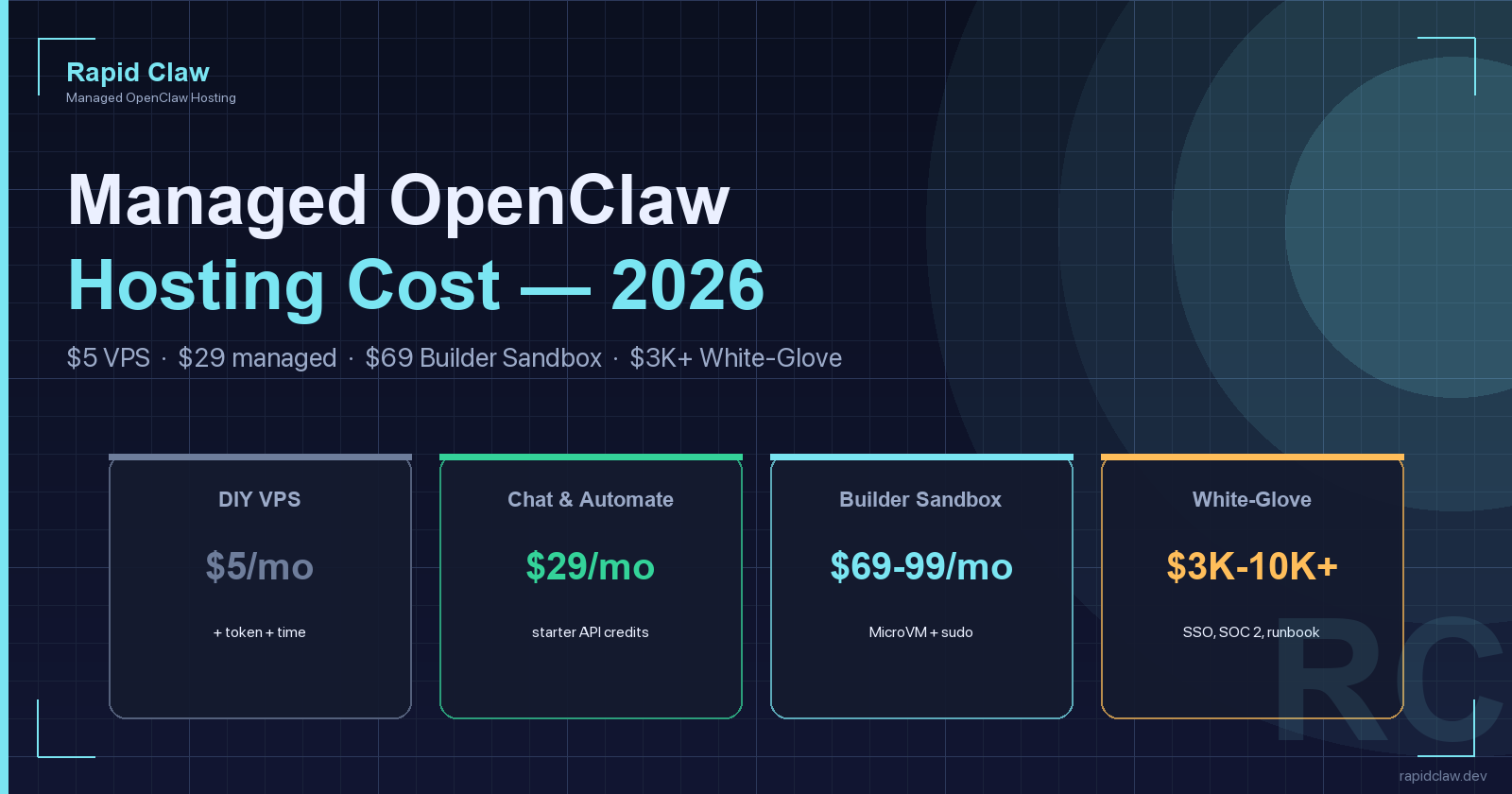
Four paths. $5/mo DIY VPS if you have the engineering hours. $29/mo Chat & Automate for everyone who would rather skip the setup. $69 to $99/mo Builder Sandbox for developers who need sudo, port forwarding and a real MicroVM. $3K to $10K+ White-Glove for regulated or custom builds. Plan on Claude API tokens on top of any of these. The first six weeks of running Rapid Claw in production taught us where the hidden line items live.
All four tiers, side by side:
[See Pricing] All Four TiersThe Operator’s Actual Decision
Most cost questions about OpenClaw collapse into a single decision. You are picking one of four cost paths, and the difference between them is not a feature list. It is who owns the next emergency at 3am, who patches the CVE before the disclosure email gets read, and how much of your own time you are willing to convert into uptime. We started Rapid Claw in production on March 28th. Forty-five days of running our own service against real customer workloads has given us a clean view of where each path actually lands.
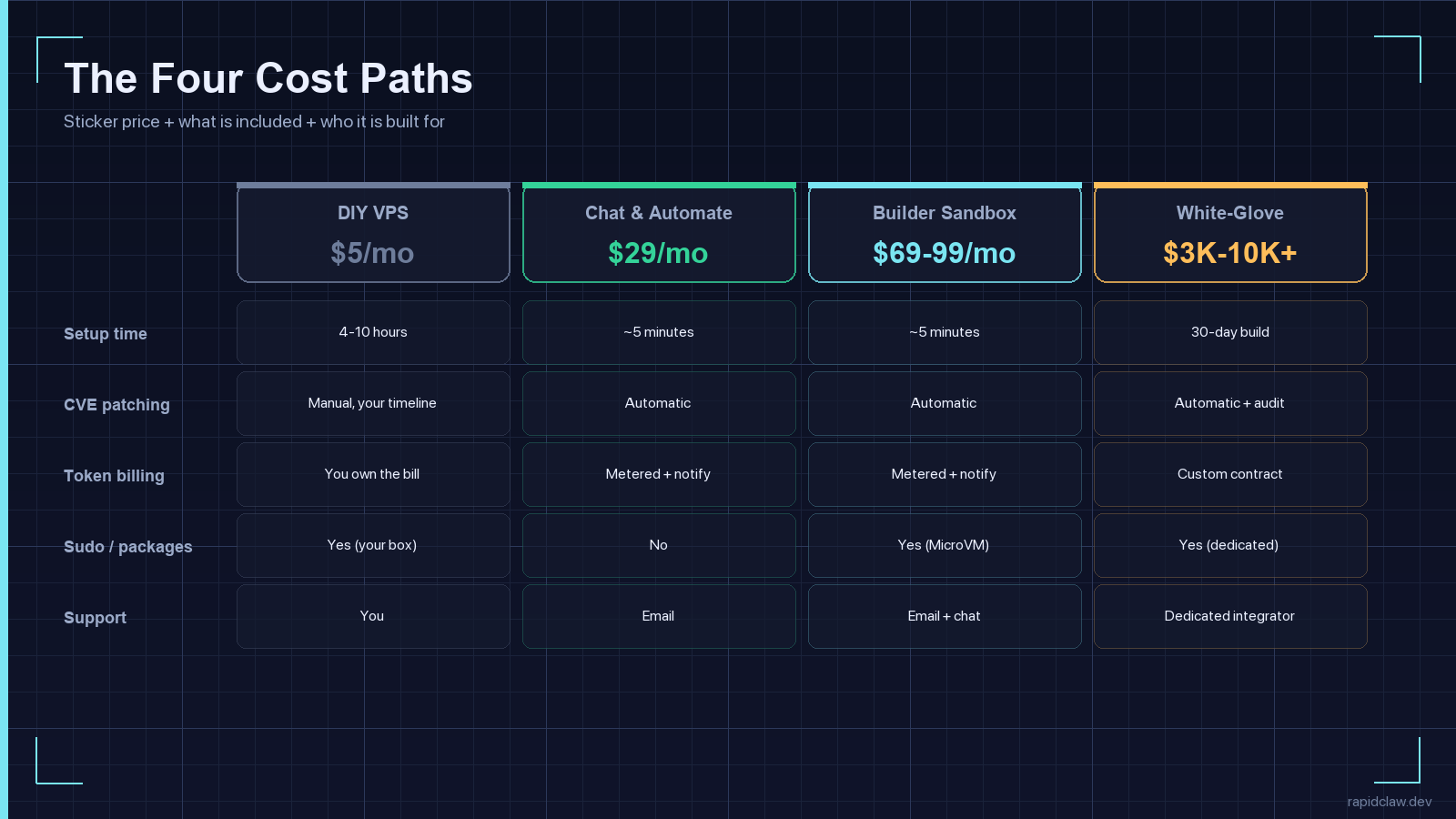
The four paths, with sticker prices, are: a $5 VPS where you run the binary yourself; Chat & Automate at $29 a month where we run it and you bring a system prompt; Builder Sandbox at $69 to $99 a month where you get a MicroVM with sudo and port forwarding for development work; and White-Glove at $3,000 to $10,000 and up for enterprise rollouts with SSO, compliance review and a custom runbook. The right answer depends on three questions that show up in the matrix at the end of this piece.
The Four Cost Paths
DIY VPS at $5/mo
A Hetzner CX22 or DigitalOcean nano droplet runs about five dollars in cash. That number gets repeated as if it were the all-in cost. It is not. You add the Claude or OpenAI API spend (token economics do not change just because you self-host), the initial setup of 4 to 10 hours, and the maintenance tax that averages 1 to 3 hours every month between CVE patches, certificate renewals and the occasional broken upgrade. We walk through the line-by-line numbers in our DIY versus managed cost piece. The short version is that a $5 droplet usually runs $37 to $109 a month in real cash plus another $50 to $150 in opportunity cost depending on how you value your time.
Chat & Automate at $29/mo
The floor of our managed offering. One agent on shared isolated infrastructure with automatic CVE patching, smart routing on the model layer, and a starter pool of Claude API credits. Setup is about five minutes. We meter token usage and notify before any overage hits your card. The plan is built for the non-developer operator and the developer who would rather not run another box. If you are unsure where you fit, this is almost always the right place to start.
Builder Sandbox at $69 to $99/mo
A MicroVM with sudo, custom package installation, and inbound port forwarding for development work. The audience is the developer who wants managed convenience but is doing things that the shared-tenant Chat & Automate plan was not built for. Running a local model alongside the agent, exposing a port for a webhook tester, installing a niche apt package, this is the tier where those become trivial rather than a fight against the sandbox.
White-Glove at $3,000 to $10,000+
The number on the page is a setup fee plus a monthly run cost. Enterprise rollouts where someone needs to be on a call with your security team and your CTO. We do the SSO wire-up, the SOC 2 paperwork, the data residency review, and the custom routing matrix. If you have a regulated workload or a compliance team that needs a signed contract before any data moves, this is the tier. We run it as a fixed-fee 30 day build with one senior integrator end to end.
Hidden Costs Nobody Discloses
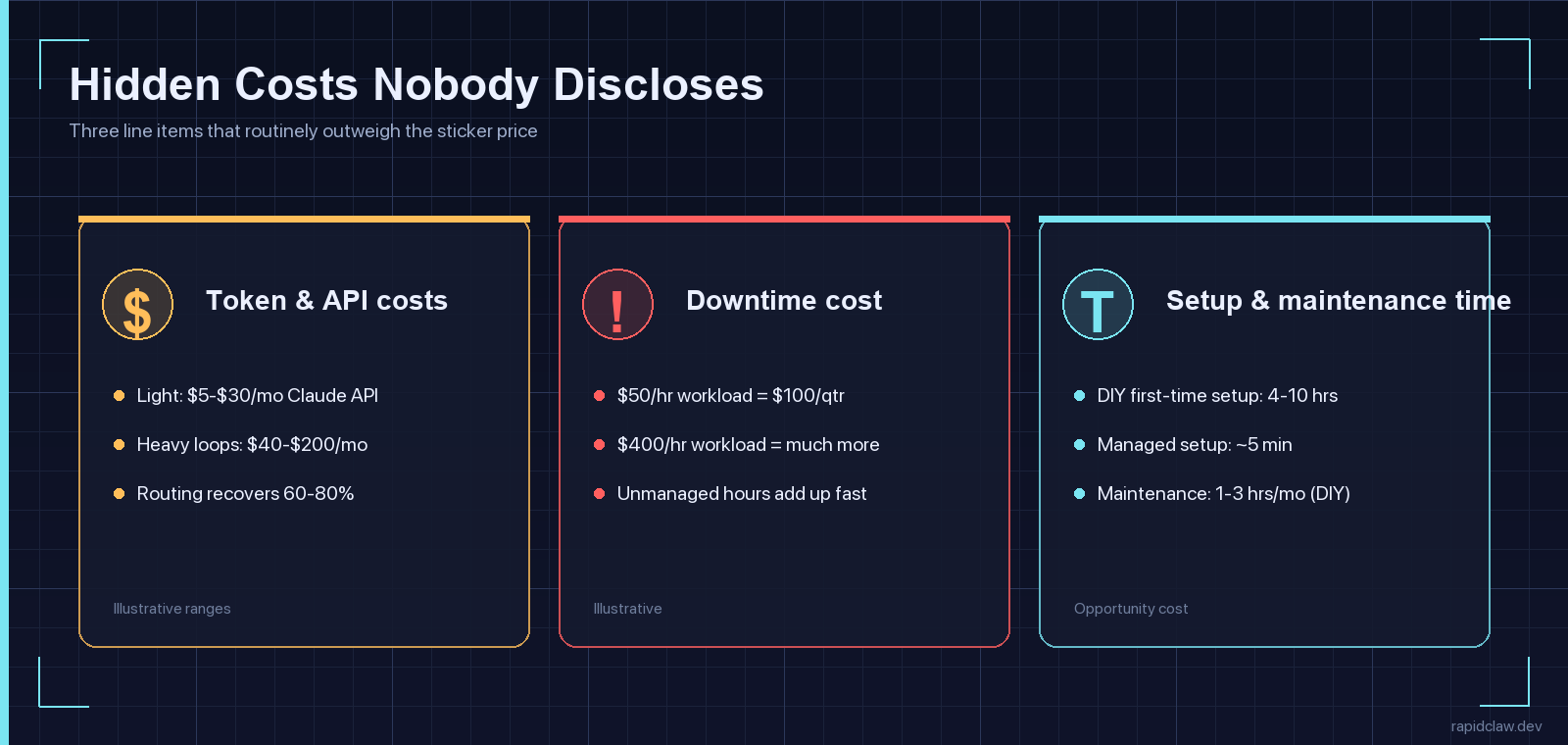
The sticker price gets all the airtime. The three line items below get almost none, and they routinely add more to the monthly bill than the platform fee itself. Treat these as the questions to ask before you commit to any path.
Token and API costs
OpenClaw is an agent. Agents call models. Models cost money. A self-hosted setup does nothing to change that. Illustrative ranges: a light personal-assistant workload runs $5 to $30 a month in Claude API spend. A heavier automation that drives loops, retrieval and tool use lands in the $40 to $200 range without optimization. Routing to a cheaper model on simple turns is where managed services earn most of their margin back for the user. The same routing logic is doable on a DIY box, but you write it yourself. Our breakdown on why unrouted agents burn six figures a year covers the math at scale.
Downtime cost
If your agent runs paid support automation, a sales workflow or scheduled jobs that ladder into revenue, an hour of downtime carries a cash value. Pick the number that matches your workload. If the agent moves $50 an hour of value, two hours of unmanaged downtime a quarter is $100. If it sits closer to $400 an hour, the number rises with it. Most operators we talk to never write this line down. Writing it down once tends to settle the managed-versus-DIY question by itself.
Setup time
DIY setup is 4 to 10 hours the first time you do it. At $50 an hour of self-valuation that is $200 to $500 you spent before the agent answered its first prompt. Managed setup is about five minutes. If you have done it three or four times already and you enjoy the work, the DIY number is fine. If your time has any other use, the managed setup time is a saved afternoon.
Where the bill quietly grows
The platform fee is the visible cost. Token spend, downtime cost and your setup hours are the invisible ones. The first six weeks of operating Rapid Claw on our own platform have made this lopsidedly clear. Operators who priced their time fairly stayed put. Operators who priced it as zero ended up back here within a month asking us to move them across.
Honest Reliability, Forty-Five Days In
Competitors in this space publish 99.99% uptime claims on their pricing pages. We will not, because we cannot prove it yet. What we can do is name the three places we have watched our own service dip during the first six weeks of running it, what we did about each one, and what the response looks like the next time it happens. The honesty is the differentiator. Operators distrust round-number vanity claims, and they are right to.
Claude API outages
When Anthropic has a regional incident, every OpenClaw deployment that talks to Claude feels it. We have seen this happen twice during the first 45 days of production. The response is failover to a backup model where the skill is compatible, plus a clear status banner so customers know it is upstream and not us. We are working on a more graceful degraded mode that picks a cheaper model class automatically when latency crosses a threshold on the primary route.
OpenClaw release bugs
Upstream OpenClaw moves quickly. Most release weeks bring a clean tag. One release during our first six weeks shipped a regression that affected long-running skill state on certain workloads. We held the upgrade for a day after the patch landed, ran it on our internal tenants first, and then promoted it across the fleet. Self-hosters who pulled the regressed tag straight to production caught a rough afternoon. Our managed users did not see the regression at all.
Our own infrastructure
We have had one self-inflicted incident worth naming. A worker queue saturated on an unusual workload pattern, requests started slowing, and we did not have alerting in place that fired fast enough. We posted publicly, refunded the affected customers proactively, and shipped two changes the same week: tighter queue instrumentation and a circuit breaker on the slow path. The fix held. We will keep posting about the next ones as they happen, because the operators we want to attract value the post-mortem more than the marketing claim.
What we will not write on a pricing page
A 99.99% uptime number is a four-decimal commitment we have not earned yet. Six weeks of production is enough to spot the failure modes, not enough to publish a real availability claim. When we have it, we will. Until then, the operators reading this deserve the actual picture.
Decision Matrix
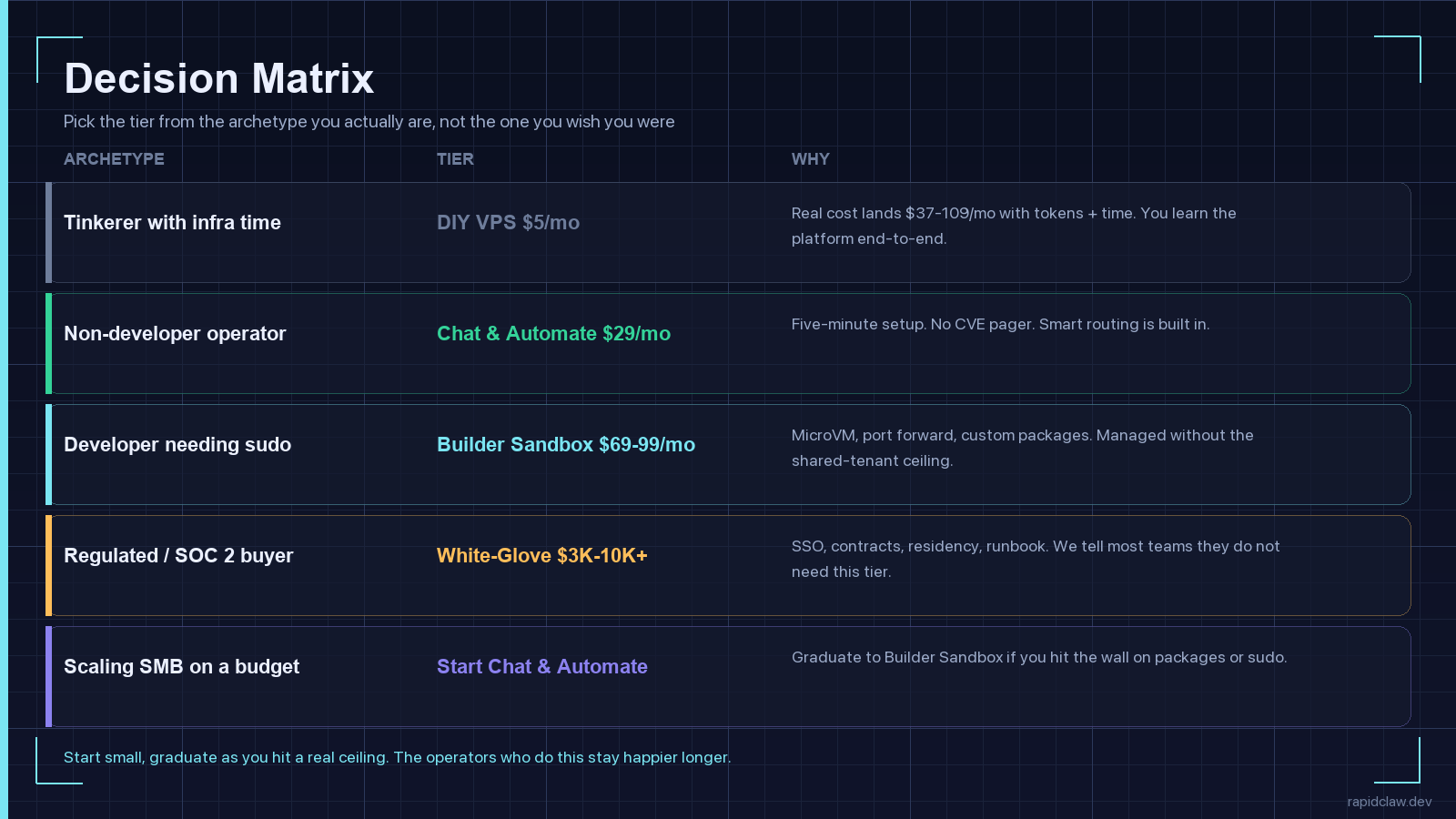
| Archetype | Tier | Why |
|---|---|---|
| Tinkerer with infra time | DIY VPS $5/mo | You will learn the platform end to end. Real cost lands at $37 to $109 once you count tokens and time. |
| Non-developer operator | Chat & Automate $29/mo | No setup. No CVE response on your weekend. Token routing built in. |
| Developer needing sudo | Builder Sandbox $69-99/mo | MicroVM, port forwarding, custom packages, isolation. Managed convenience without the shared-tenant ceiling. |
| Regulated / SOC 2 buyer | White-Glove $3K-10K+ | SSO, contracts, data residency, runbook handoff. We tell most teams they do not need this. |
| Scaling SMB on a budget | Chat & Automate $29/mo first | Start small. Graduate to Builder Sandbox if you hit the wall on packages or sudo. |
One pattern we have noticed in the first month and a half of production: operators who start on Chat & Automate and then graduate to Builder Sandbox are happier than operators who start on Builder Sandbox cold. The lower tier teaches you what you actually need before you pay for the upgrade. The complete trade-off grid lives on the pricing page, and our broader take on where AI agent hosting fits in 2026 covers adjacent platforms.
Try Rapid Claw on the floor tier
Chat & Automate at $29/mo. No setup, smart routing on the model layer, throttle-and-notify on overage. Cancel in ten seconds.
Start Free Trial — 5 msgs, then $29/mNo credit card to start · Cancel anytime in 10 seconds
Frequently Asked Questions
What’s the cheapest way to host OpenClaw?
A $5 VPS gets the binary running. That price covers compute only. You still pay for the Claude or OpenAI API calls the agent makes, the 4 to 10 hours of setup the first time, and the maintenance hours that pile up over a year. Cheapest in cash, almost never cheapest once you count your time.
Is managed worth it over self-hosting?
For a solo operator or small team without dedicated infra staff, managed at $29/mo usually wins on total cost once you price your hours fairly. The break-even falls below $10/hr of self-valuation. Self-hosting wins when you have a person whose job description includes infrastructure and you process more than a few hundred dollars of tokens monthly.
What’s the actual monthly cost including tokens?
Plan on the platform fee plus your model API spend. Light usage on Chat & Automate ($29/mo) plus a personal-assistant workload typically lands between $35 and $75 a month all-in. A heavier Builder Sandbox workload with agent loops can push the API line into the low hundreds before any routing optimizations. We meter and notify before charges land.
How much does Builder Sandbox cost and who needs it?
Builder Sandbox runs $69 to $99 a month depending on resource ceiling. You get a MicroVM with sudo, port forwarding, and isolation from the shared tenant pool. The audience is developers who want managed convenience but need to install custom packages, run a local model, or expose a port for inbound testing.
When does White-Glove pricing make sense?
White-Glove starts at $3,000 setup and climbs past $10,000 for regulated workloads. Buyers at this tier carry SOC 2 review boards, dedicated SSO requirements, or routing matrices nobody else can fit. We do the migration, security paperwork, and runbook handoff. For most teams this is overkill, and we say so.
Does $29/mo cover token usage too?
Chat & Automate includes a starter pool of Claude API credits. After that, additional model usage is metered. We chose throttle-and-notify rather than auto-charge, so a runaway agent loop slows and pings you before it touches your card.
What happens to my OpenClaw if Rapid Claw has an outage?
We have watched our own service dip during the first six weeks of production. The dips fall into three buckets: Claude API outages we cannot control, OpenClaw release bugs that we patch as fast as upstream, infrastructure issues on our side that we own publicly. We post status updates and keep skill state durable so a restart picks up where the agent left off.
Related reading
The line-by-line numbers for the $5 VPS path
Why unrouted agents cost $100K a yearThe token math behind agentic workloads
AI agent pricing models comparedPer-seat, per-resolution, per-task at volume
AI agent hosting: the complete 2026 guideWhere managed OpenClaw fits next to Railway, Modal and RunPod