Agentic Commerce Is Here: What It Means for Your Store in 2026
April 22, 2026·14 min read
Your next customer might not be a person. It might be an AI agent with a credit card, a preference model, and zero patience for slow product pages. Agentic commerce — where autonomous AI agents browse, compare, negotiate, and buy — is projected to grow from $547M to $5.2B by 2030. Here is everything you need to know.
What Is Agentic Commerce?
Agentic commerce is the next evolution of e-commerce where AI agents act as autonomous buyers. Instead of a human scrolling through Amazon, clicking “Add to Cart,” and checking out — an AI agent does all of it. Browsing product catalogs, comparing prices across vendors, reading reviews, negotiating where possible, and completing the purchase.
Think of it as going from “I searched for running shoes” to “My agent found the best deal on the exact shoes I wanted, applied a coupon code, and they are arriving Thursday.” The human sets the intent. The agent executes.
This is not theoretical. 58% of consumers have already replaced traditional search with AI for product recommendations according to Salesforce’s 2026 Connected Shopper Report. Google’s AI Overviews now handle 40%+ of product queries. Amazon’s “Buy for Me” feature lets an AI agent purchase items from third-party sites without the user ever leaving Amazon.
The Numbers: $547M → $5.2B
The agentic AI market in commerce was valued at roughly $547 million in 2025. Multiple analyst firms project it will hit $5.2 billion by 2030, representing a 45–65% CAGR. That is not hype — it is backed by real deployment numbers.
- McKinsey estimates $3–5 trillion in global retail spend could be redirected through AI agents by 2030
- Gartner predicts 25% of enterprise procurement will be agent-mediated by 2028
- Salesforce reports 58% of consumers already use AI for product recommendations
- Amazon “Buy for Me” processed over 2M agent-initiated transactions in Q1 2026
The growth is not just in consumer retail. B2B procurement, supply chain management, and wholesale purchasing are all seeing agent adoption. When an AI agent can negotiate vendor pricing, manage reorder points, and optimize inventory across warehouses — the ROI is immediate and measurable. For a wider view of where agent-to-agent commerce gets monetized, the AI agent marketplace economics breakdown covers the platforms making this discoverable.
The early adopters on the merchant side aren’t Amazon or Shopify Plus accounts — they’re independent operators. See how single-founder Shopify and Etsy shops are wiring OpenClaw into order-routing and customer-service triage for the playbook one rung below enterprise.
How Shopping Agents Actually Work
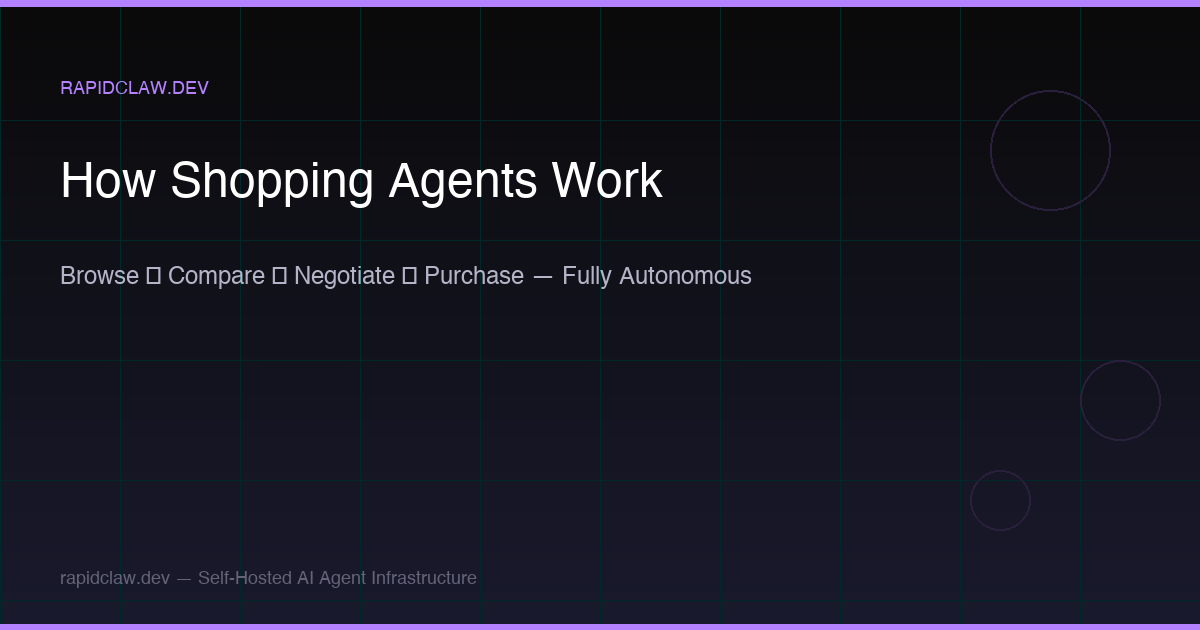
A shopping agent is not a chatbot with a product database. It is an autonomous system that executes a multi-step purchasing workflow. Here is the typical flow:
- Intent Capture — The user expresses a need: “Find me noise-canceling headphones under $300 with at least 30 hours battery life.”
- Discovery & Browsing — The agent crawls product catalogs, APIs, and retail sites. It does not rely on a single search engine — it queries multiple sources simultaneously.
- Comparison & Evaluation — Agents weight factors the user cares about: price, reviews, shipping speed, return policy, brand reputation. They build a ranked shortlist.
- Negotiation — Where supported, agents can negotiate pricing, apply coupon codes, stack discounts, or time purchases around sales events.
- Purchase Execution — The agent completes checkout, handles payment authentication, and confirms the order.
- Post-Purchase — Tracking shipments, initiating returns, leaving reviews — the agent manages the entire lifecycle.
The key difference from traditional comparison-shopping tools: agents maintain persistent memory. They learn your preferences over time. They know you returned those Sony headphones because the ear cups were too small. They remember you prefer matte black over glossy. Each purchase makes the next one better. (Letting an agent shop on your behalf also opens an attack surface — the prompt injection defense playbook is required reading before you wire one up to a real card.)
The Platform Race: Who Is Building Agentic Commerce
Every major tech company is racing to own the agentic commerce layer. Here is where the biggest players stand:
Amazon
Rufus AI handles product Q&A. "Buy for Me" lets agents purchase from third-party sites. Alexa+ integrates agent shopping into voice. Amazon controls the checkout rails — that is their moat.
Shopping Graph indexes 45B+ product listings. AI Overviews surface agent-friendly comparisons. Google Lens enables visual product search that agents can leverage programmatically.
OpenAI
Operator is OpenAI's agent that navigates websites autonomously. It can browse, fill forms, and complete purchases. ChatGPT plugins already handle product recommendations for 100M+ users.
Shopify
Sidekick handles merchant-side agent tasks. Shop AI powers consumer-facing product discovery. With 4.6M merchants, Shopify is making every storefront agent-accessible by default.
Perplexity
Perplexity Shopping launched "Buy with Pro" — one-click purchasing directly from AI search results. No merchant fees. Free shipping. They are attacking the Google Shopping model head-on.
Agentic SEO vs Traditional SEO
If AI agents are doing the shopping, who are you optimizing for? Not the human typing “best running shoes 2026” into Google. You are optimizing for the agent that queries your product API, parses your structured data, and decides whether to recommend you — all in milliseconds.
This is agentic SEO, and it requires a fundamentally different approach:
| Dimension | Traditional SEO | Agentic SEO |
|---|---|---|
| Audience | Human searchers | AI agents + LLMs |
| Content format | Blog posts, landing pages | Structured data, APIs, machine-readable feeds |
| Ranking signal | Backlinks, domain authority | Data accuracy, API reliability, response speed |
| Discovery | Google SERP position | Agent tool registry, MCP servers, product APIs |
| Conversion | Click → Browse → Buy | Query → Evaluate → Auto-purchase |
| Optimization | Title tags, meta descriptions | Schema markup, OpenAPI specs, pricing APIs |
The businesses that win in agentic commerce will be the ones that make their products discoverable by machines, not just humans. That means clean structured data, reliable APIs, consistent pricing feeds, and fast response times. If an agent cannot parse your product catalog in under 200ms, it will move on to a competitor that it can. The flip side — keeping your own shopping agent from getting rate-limited by every retailer it queries — is a problem of production guardrails and rate-limit budgets, not raw model quality.
How Self-Hosted Agents Power Agentic Commerce
Here is the opportunity most businesses are missing: you do not have to wait for Amazon or Google to build your shopping agent. You can deploy your own.
Self-hosted AI agents — running on infrastructure you control — give businesses the ability to build custom shopping experiences that no platform can replicate. A self-hosted agent can:
- Act as your store’s personal shopper — guiding customers through complex product catalogs with contextual recommendations
- Handle B2B procurement — negotiating volume pricing, managing purchase orders, and tracking vendor contracts
- Monitor competitor pricing — adjusting your prices in real-time based on market conditions
- Manage inventory autonomously — predicting demand, placing reorders, and optimizing warehouse allocation
- Process returns and support — handling post-purchase workflows without human intervention
Why self-hosted matters for commerce
When your shopping agent handles payment data, customer preferences, and purchasing history — you need full control over where that data lives. Self-hosted agents on RapidClaw run in isolated containers with AES-256 encryption, meaning your customer data never touches a third-party platform. See the AI agent hosting guide for infrastructure tradeoffs. Deploy in 5 minutes, scale as your catalog grows.
What You Should Do Right Now
Agentic commerce is not coming — it is here. The businesses that prepare now will capture disproportionate value as agent-mediated purchasing scales. Here is your action plan — and if you're evaluating where to host the agent itself, the RapidClaw vs xCloud comparison covers the two managed options operators ask about most.
- Audit your structured data — make sure your products have complete Schema.org markup, clean pricing data, and accurate inventory status
- Build or expose product APIs — agents cannot scrape your JS-rendered product pages reliably. Give them a clean API endpoint.
- Deploy a shopping agent for your store — start with a self-hosted AI agent that handles product recommendations and customer Q&A
- Monitor agent traffic — set up analytics to distinguish agent visitors from human visitors. Agent traffic patterns look different — high API calls, low page views, no session cookies.
- Optimize for speed — agents evaluate response time as a ranking signal. Sub-200ms API responses win.
Related Articles
Ready to Deploy
Deploy your commerce agent in 5 minutes
Self-hosted AI agents with isolated containers, AES-256 encryption, and CVE auto-patching. Your customer data stays on your infrastructure.
AES-256 encryption · CVE auto-patching · Isolated containers · No standing staff access