April 22, 2026·
Stanford AI Index 2026: 12 Key Takeaways for Builders
Stanford HAI just dropped its 9th annual AI Index Report — 400+ pages across 9 chapters. We read all of it so you don't have to. Here are the 12 takeaways that actually matter if you're building, deploying, or self-hosting AI agents.
1. GenAI Hit 53% Adoption in 3 Years — Fastest Ever
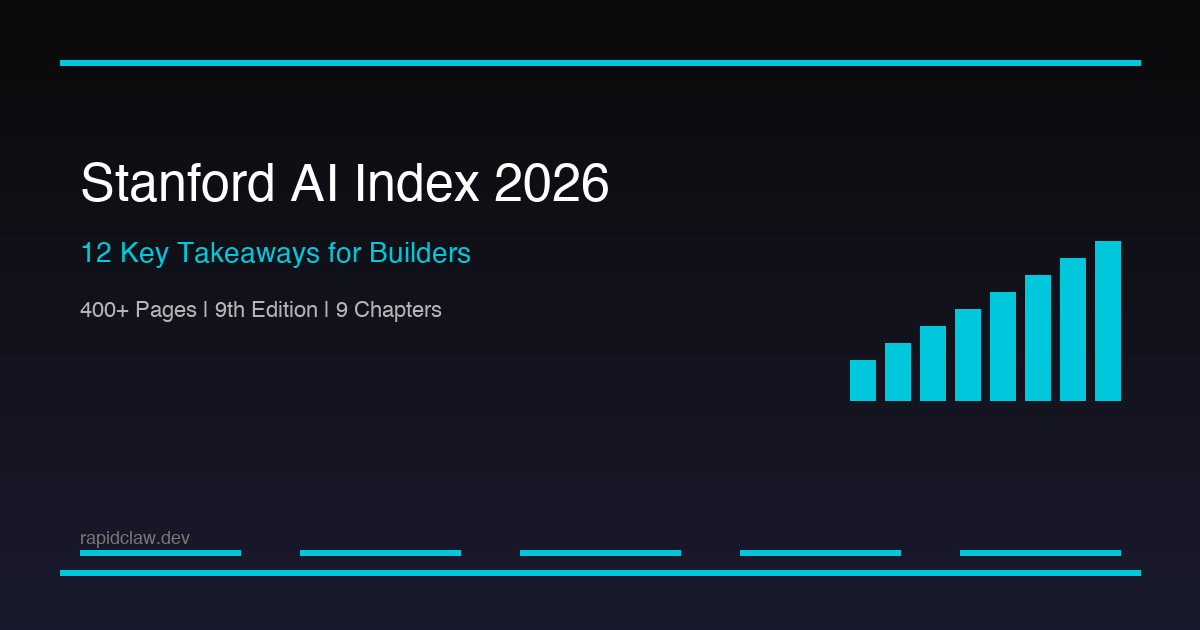
The PC took 15 years. The internet took 7 years. GenAI reached 53% population adoption in just 3 years. That's not a trend — that's a phase transition. If you're building AI-powered products, the market isn't "emerging" anymore. It's here.
For builders, this means the window for early-mover advantage is closing fast. The question isn't "should we use AI?" anymore — it's "how do we deploy AI agents that actually deliver ROI before our competitors do?"
2. SWE-bench Coding: 60% to Near 100% in One Year
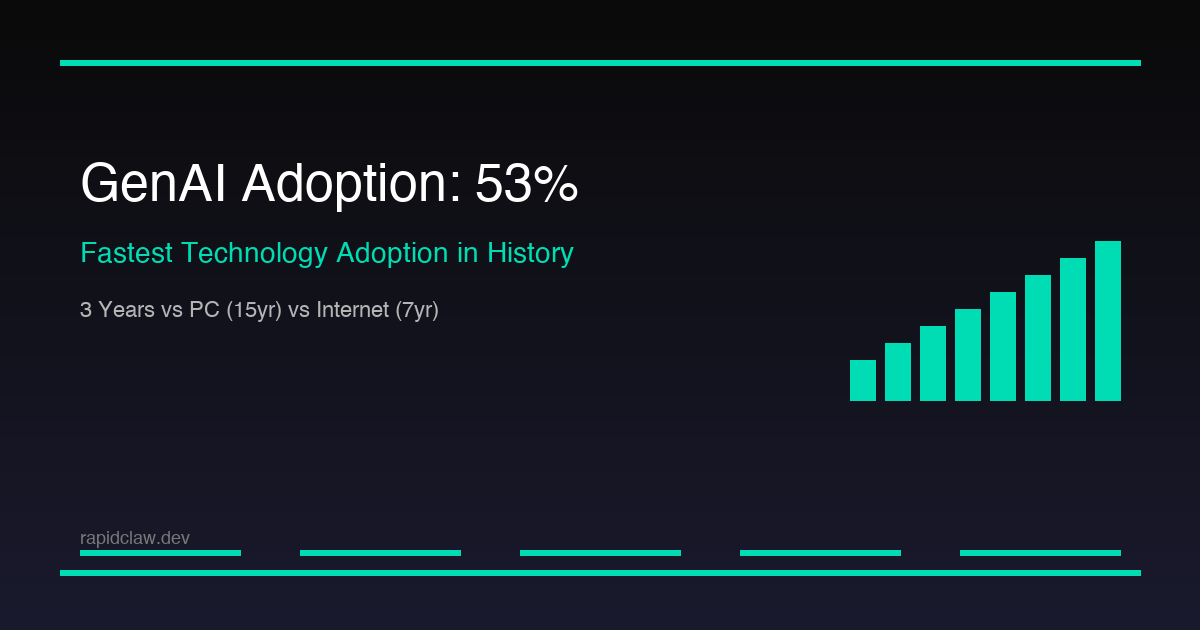
SWE-bench measures how well AI can solve real GitHub issues — actual pull requests on actual repos. In one year, top models went from 60% to near-perfect scores. AI isn't just autocompleting code anymore. It's resolving production bugs autonomously.
This is the single most relevant metric for anyone building agentic workflows. If your AI agent needs to write, debug, or refactor code as part of its job, the capability ceiling just disappeared. For how today's numbers shake out across models, see our 2026 AI agent benchmarks roundup.
3. Anthropic Leads Top Benchmarks — By Just 2.7%
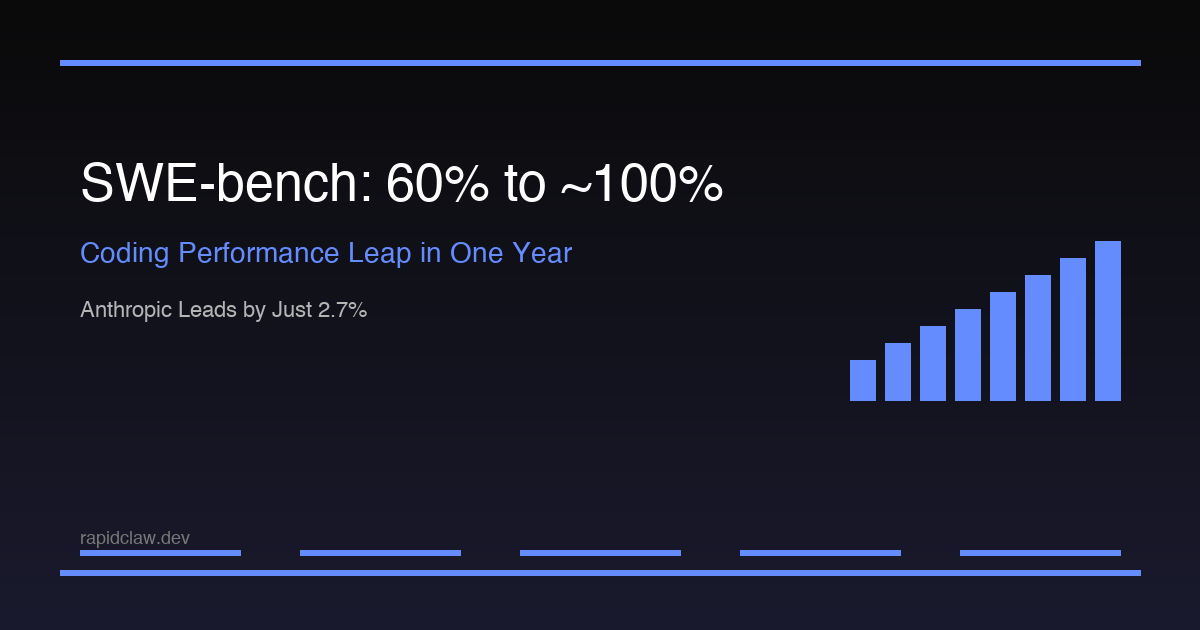
The performance gap between top model providers has collapsed. Anthropic leads the pack on aggregate benchmarks, but by only 2.7%. OpenAI and Google are right behind. The era of one model dominating everything is over.
What this means for you: Model choice is becoming a commodity decision. The real differentiator isn't which model you use — it's how you deploy it, what workflows you wrap around it, and how you manage costs. This is exactly why platforms like RapidClaw let you bring your own API keys and swap models without re-architecting — the multi-model routing playbook walks through how to do it.
4. AI Scholar Migration to the US Dropped 89% Since 2017
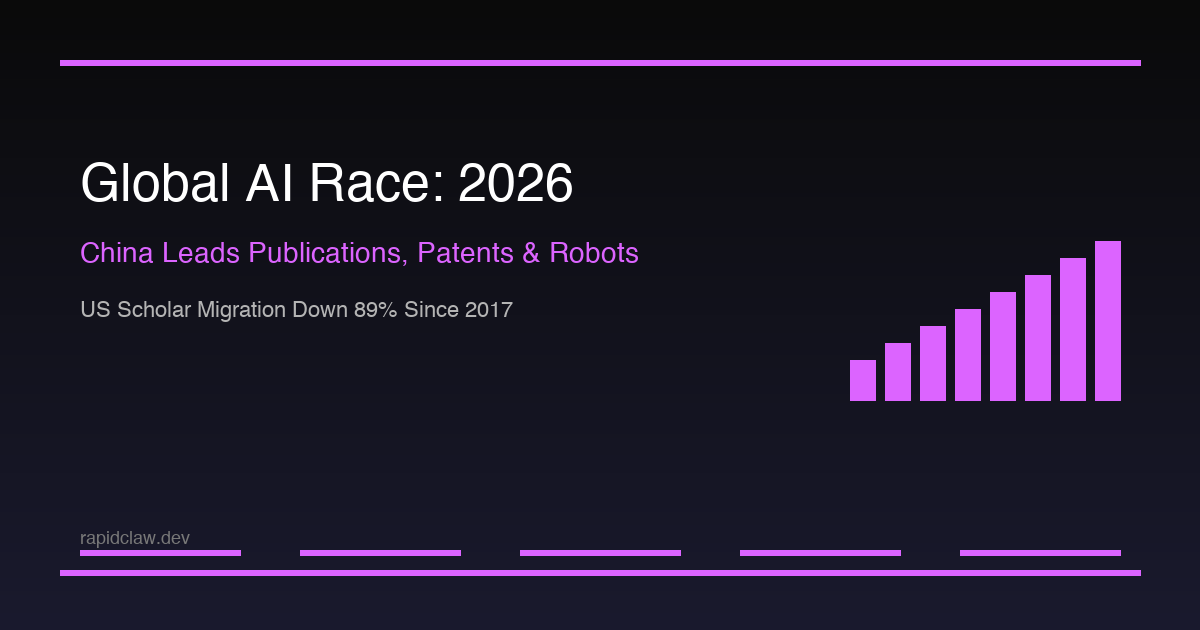
The US used to be the unquestioned magnet for global AI talent. Not anymore. Inbound AI researcher migration has dropped 89% since 2017. Visa restrictions, competition from other hubs, and remote-first culture have all contributed.
For founders, this means the talent pool is increasingly distributed. Building an AI company no longer requires a Bay Area office. The talent is everywhere — and so are the deployment options.
5. China Leads in Publications, Citations, Patents & Robots
China now leads the world in AI publications, citations, patent filings, and industrial robot installations. The US still leads in private investment and frontier model development, but the gap is narrowing on every metric the Index tracks.
The takeaway for builders: the AI ecosystem is multipolar. If you're deploying agents that interact with global markets, you need to be aware that the innovation centers are shifting. Models trained on Chinese research datasets, robotics built in Shenzhen, and regulation shaped in Brussels all affect your stack choices.
6. Foundation Model Transparency Index: 58 → 40
The Stanford Foundation Model Transparency Index measures how much major model providers disclose about training data, compute, safety testing, and downstream usage policies. It dropped from 58 to 40 — a significant decline.
Translation: the big labs are becoming less transparent, not more. They're sharing fewer details about training data sources, safety evaluations, and compute costs. For anyone building on top of these models, this is a real risk — you're building on a black box that's getting blacker.
7. Open-Source Models Are Closing the Gap
The gap between open-source and proprietary models continues to shrink across every benchmark. Models like Llama, Mistral, and Qwen are now competitive with GPT-4 and Claude on most tasks. The performance delta is small enough that deployment flexibility matters more than raw benchmark scores.
This is massive for self-hosting. When open-source models hit 90-95% of frontier performance, the calculus changes completely. You get full data control, no per-token markup, and the ability to fine-tune for your specific domain. The Index data confirms what builders have been feeling: self-hosted AI is no longer a compromise — it's a strategy.
8. AI Private Investment Hit Record Highs
Global private AI investment surged again in 2025, driven primarily by foundation model companies and infrastructure plays. The concentration is extreme — a handful of companies absorbed the majority of funding. Most of it went to compute infrastructure, not applications.
For indie builders and small teams, the signal is clear: the infrastructure layer is getting commoditized by big capital, which means the application and deployment layer is where small players can still win. Build on top of the infrastructure — don't try to compete with it.
9. AI Regulation Is Accelerating Globally
The number of AI-related regulations worldwide has exploded. The EU AI Act is now in enforcement, the US has new executive orders, and China has its own framework. The compliance surface area for AI deployments just got a lot bigger.
Self-hosted deployments have a natural advantage here. When you control where your data lives, which models process it, and how outputs are logged, compliance becomes engineering rather than negotiation with a vendor's legal team. See our guides on GDPR & EU AI Act compliance and SOC 2 / HIPAA for AI agents for the playbooks.
10. Benchmarks Are Saturating — New Metrics Needed
Many traditional AI benchmarks — MMLU, HumanEval, GSM8K — are effectively solved. Models score 90%+ on tasks that were considered frontier just 18 months ago. The Index highlights a growing need for agentic benchmarks that measure multi-step reasoning, tool use, and real-world task completion.
This matters because benchmark scores alone can't tell you if a model will work well as an autonomous agent. The metrics that matter now are reliability over long sessions, error recovery, and cost-per-completed-task — things you can only measure in production deployments.
11. Inference Costs Dropped 10x in 18 Months
The cost of running frontier models has plummeted. What cost $10 per million tokens in early 2024 now costs under $1 for equivalent performance. Inference is getting cheap enough that the deployment and orchestration layer becomes the dominant cost — not the model itself.
This is why RapidClaw's bring-your-own-key model works. When tokens are cheap, the value is in the infrastructure that keeps your agents reliable, secure, and observable — not in marking up API calls. The hosting guide covers the deployment piece in detail.
12. What This All Means for Self-Hosted AI Agents
The 2026 AI Index paints a clear picture for anyone in the self-hosted AI space:
- Open-source models are good enough. The performance gap with proprietary models is small and shrinking. Self-hosting is no longer a compromise.
- Transparency is declining. Big labs share less about their models every year. Self-hosting with open-weight models gives you the transparency that proprietary APIs no longer offer.
- Regulation favors control. When you own the deployment, compliance is a tractable engineering problem, not a vendor dependency.
- Costs are collapsing. Cheap inference + bring-your-own-keys = the deployment layer is where the value is. Not the model.
Ready to Deploy Your Own AI Agents?
RapidClaw gives you dedicated VPS infrastructure for self-hosted AI agents — no per-token markup, full data control, and white-glove deployment support.
Deploy in 5 Min — 5 msgs free, then $29/mKeep reading
- What Is OpenClaw? — the self-hosted agent runtime explained
- AI Agent Hosting: Complete Guide — pick the right infrastructure for production
- AI Agent Benchmarks 2026 — how today's models actually compare
- Beginner's Guide to AI Agents — start from first principles
- Anthropic ToS & Gemma 4 Self-Hosting — deploy your own model after the API rules changed
Source: Stanford HAI AI Index Report 2026 — 9th Edition, April 2026. All statistics cited in this article are drawn directly from the report.